David Coltart speaks on dialogue with Mnangagwa

The Zimbabwe Mail

26th June 2019

MDC Treasurer General David Coltart says the MDC will not allow a person who stole an election to dictate the terms of the much needed national dialogue.

In a Twitter conversation with Mnangagwa’s advisor Shingi Munyeza and Business Tycoon Mutumwa Mawere he said, “I would just add  we need a dialogue arbitrated by a neutral democratic peer. We cannot have one person, who even on his own figures, in a fraudulent unconstitutional election, won by a tiny margin, dictate the terms, pace, venue and structure of the dialogue.”

Coltart said the gap between legitimacy and illegitimacy of President Emmerson Mnanaggwa’s Presidency needs to be bridged so that the dialogue can be done in good faith.

“The gap has to be bridged or else our nation will continue to plunge. In South Africa in 1990 there was also a large gulf but it was bridged. Good faith can overcome massive obstacles. But we have a serious deficit of good faith.

“Legitimacy is an issue – last year’s elections were illegal, and not free and fair. All reasonable observers concede that.”

The lawyer added that the judiciary system has contributed to the national crisis in the country.

“It is also no use relying on the Constitutional Court judgment because any lawyer worth his or her salt will explain how fundamentally flawed both the procedure and judgment were. So in a dialogue it is unhelpful trying to argue that a discredited process must just be accepted.

“Clearly in the Zimbabwean context the judiciary is part of the problem, particularly since the election and this year when it has acted systematically in a manner which disrespects the rule of law and the Constitution.”

Posted in Blog | Leave a comment

Why Zimbabwe has banned foreign currencies

BBC

26th June 2019

Zimbabwe’s government has taken the controversial decision to ban local trading in foreign currencies, including the US dollar, with immediate effect.

It has also reintroduced the Zimbabwe dollar, which was abandoned because of hyperinflation in 2009 when the country mainly adopted the US dollar and the South African rand.

The move has shocked Zimbabweans, who have little faith in a local currency – the exchange rate when the Zimbabwe dollar was scrapped was Z$35 quadrillion to $1.

What has prompted the move?

The economy is a mess. Nearly everything is imported and there is a shortage of physical cash. The cost of living is very expensive. Unemployment is widespread.

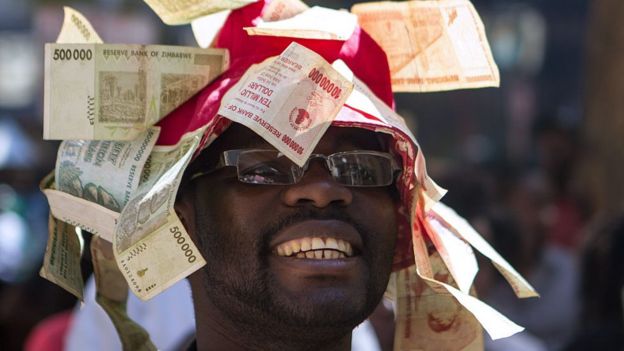
A man wearing a hat decorated with worthless notes, Harare, Zimbabwe - 2016
Image captionZimbabwe’s old currency became absolutely worthless

Various things have been tried to solve the problem, including the introduction in 2016 of bond notes, a parallel currency that was only accepted in Zimbabwe.

It was officially pegged to the US dollar but in reality was worth much less – so a thriving black market developed and Zimbabwe has become a cashless society, relying on card-based transactions or trading with mobile money.

Presentational grey line

In February, bond notes and electronic cash were re-branded RTGS dollars and allowed to float to try and crush the black market.

However, workers, who used to get their salaries paid in US dollars, have found that their salaries in RTGS dollars are not able to keep up with inflation – now running at 100%.

People were often expected to pay for goods in shops and services, like doctors’ fees, in US dollars.

President Emmerson Mnangagwa said the ban was an “important step in restoring normalcy to our economy”.

“While the multi-currency regime helped stabilise the economy, it did not give us control of monetary policy and left us at the mercy of US dollar pricing which has been a root cause of inflation,” he added.

The authorities also say because the US dollar is so strong, producing goods locally is expensive which is why businesses prefer to import goods.

What has been the reaction?

Anger and exasperation.

A list of new prices in Zimbabwe dollars for electrical products in a supermarket in Harare, Zimbabwe, 24 June 2019
Image captionSome retailers have produced new prices lists: here an iron that usually costs about $30 is priced at Z$104

Most people, who associate the Zimbabwe dollar with food shortages and runaway inflation, have complained about the lack of warning. The RTGS officially became the Zimbabwe dollar on Monday, the only legal tender.

“We should have our own currency. But they shouldn’t have abolished it as if they were swatting a fly. They should have given us notice,” one man told the BBC.

Supermarkets and those in the formal sector responded a day after the announcement by issuing new prices in Zimbabwean dollars – but they were beyond the means of many.

A first-time doctor’s consultation is now Z$1,800 – more than a teacher or nurse earns in a month.

Informal traders, who dominate the economy and need US dollars for imports, have vowed to defy the directive.

A street vendor in the capital, Harare, told the BBC: “How is it possible that the US dollar is no longer accepted? It won’t work. We actually want greater use of it, so that as street vendors we can have them. Scrap the bond note instead.”

Opposition Movement for Democratic Change (MDC) lawmaker David Coltart called the move “sheer madness”.

“The market has been re-dollarising because of lack of confidence in the RTGS dollar. You can’t force people to love a currency… This will exacerbate the chaos,” he said on Twitter.

Will these objections make any difference?

The trade unions have threatened “mass action” if the policy is not reversed.

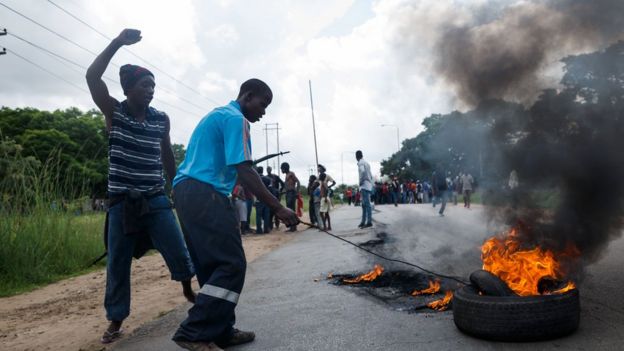
A man sets tyre on fire as angry protesters barricade the main route to Zimbabwe's capital Harare from Epworth township - January 2019
Image captionUnrest broke out after a fuel price hike in January

The Zimbabwe Congress of Trade Unions (ZCTU) wants workers to be paid in US dollars again.

In January, it led nationwide protests against a 150% fuel price increase, triggering a violent crackdown by the army and police that rights groups say left at least 12 people dead.

On the streets of the capital, black market traders are still exchanging and accepting US dollars.

The value on the black market has remained unchanged – one US dollar is worth 11 Zimbabwe dollars, compared with the official rate of 6.2.

Ultimately Zimbabweans have proved good at adapting over the years to one economic crisis after another.

Why do Zimbabweans prefer foreign currencies?

They are scarred by the mismanagement of the economy by the government of then-President Robert Mugabe. The central bank was forced to print banknotes of ever higher values to keep up with surging inflation.

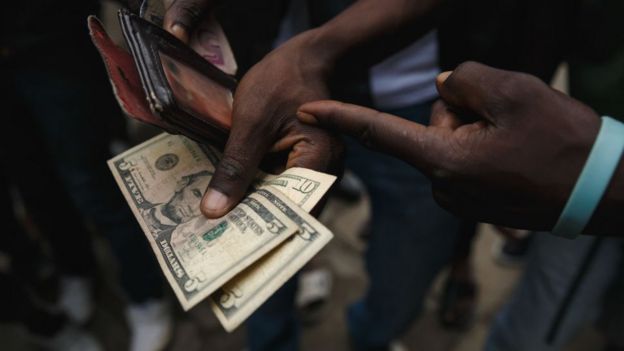
A person holding US dollars in Zimbabwe
Image captionUS dollars are the most highly prized currency in Zimbabwe

Annual inflation reached 231 million per cent in July 2008. Officials gave up reporting monthly statistics when it peaked at just under 80 billion per cent in mid-November 2008.

The prices of goods multiplied several times a day. Though it was illegal at the time, many people opted to keep US dollars, which they bought on the black market.

Businesses began demanding foreign currency. Eventually authorities were forced to catch up, scrapping the Zimbabwe dollar and sanctioning the use of several currencies, including the Chinese yuan and Indian rupee.

You could purchase something with one currency, and get change in another currency.

But in reality Zimbabwe ran out of all these currencies because it was importing far more than exporting – and has become a cashless society.

Posted in Blog | Leave a comment

Multi-currency ban: MDC slams govt’s ‘ambush’ policies

NewZimbabwe.com

By Anna Chibamu

25th June 2019

The MDC has slammed the Zanu PF led government for “ambushing” citizens through the shock scrapping of the multi-currency regime on Monday in place of the much resented return to the local currency.

Government, through Statutory Instrument 142 of 2019, announced on Monday only the local currency shall now remain legal tender, making it illegal for businesses and individuals to demand foreign currency for goods and services.

Reacting to the policy shift, MDC deputy spokesperson Luke Tamborinyoka launched an attack on the Zanu PF led administration for introducing the use of the local currency when President Emmerson Mnangagwa had initially announced this would be implemented in a space of nine months when all the fundamentals were in place.

“…The regime today (Monday) just ambushed the nation and reintroduced the Zimbabwean dollar as the only legal tender in local transactions,” Tamborinyoka said in a statement.

“This means that the multi-currency regime, which provided some modicum of decency and predictability, has been thrown out of the window in favour of the volatile local currency that is not backed by adequate gold and foreign currency reserves.

“Today’s decision shows the lack of coherent, prudent and predictable policy, which is important to retain trust and confidence in a country’s economy.

“Policy consistency and predictability are key tenets for any economy to succeed.”

Tamborinyoka said the “knee-jerk monetary policy introduced in the dead of the night is reminiscent of the rushed decisions of this regime”.

“With the current madness in government,” he added, “it is important to state that the people reserve their right to express their displeasure at the free-falling economy and the knee-jerk policies that those in authority introduce when they so wish.”

Meanwhile, the decision to scrap the basket of foreign currencies from circulation on the formal market has been met with mixed feelings by locals, businesses and politicians.

MDC Treasurer General, David Coltart warned the move by government will have dire consequences as the formal market will be driven underground causing massive shortages of imported goods.

Coltart said inflation will only be contained if the central bank resisted the temptation to print more notes.

Renowned businessman Shingi Munyeza said on twitter prices will stabilise and later fall while the parallel market will also stabilise or even come down.

Economist Steve Hanke also said the removal of foreign currencies will give President Mnangagwa and his government the green light to turn on the printing presses and run a huge fiscal deficit, driving the country into what led to hyperinflation in 2008 and 2017.

Posted in Blog | Leave a comment

Coltart Describes Ban On Use Of Foreign Currency As Sheer Madness

Zimeye

24th June 2019

By Farai Dziva

MDC Treasurer General David Coltart has described the ban on the us of foreign currency as “sheer madness.”

“I am looking into this but my initial view is that the Minister cannot use a Statutory Instrument to change the Finance Act. But that is not the main problem – because they can easily rectify that.”

“The main problem is that this goes against fundamental inviolable economic laws.”

Coltart added: “Such a shame that Minister Ncube didn’t read this sensible advice in just last Friday’s @Zimindependent

“His policy is sheer madness and will cause even greater chaos. Does he not listen.”

“As Treasurer General of the #MDC I have commented in detail. For the avoidance of doubt this is a catastrophically bad policy which will greatly exacerbate the economic crisis in #Zimbabwe.”

“Let all men know how empty and worthless is the power of kings, for there is none worthy of the name, but He whom heaven, earth, and sea obey by eternal laws” This was attributed to King Canute and Mnangagwa and Minister Ncube should remember that economic laws are the same. “

Posted in Blog | Leave a comment

MDC and the colonial ghost of whiteness

Sunday Mail (ZANU PF propaganda)

By Ranga Mataire

2nd June 2019

David Coltart, the self-confessed former British South African Police (BSAP) member, who authored a rehashed moribund autobiography, recently rebounded as treasurer of the MDC at the party’s congress held in Gweru.

It is almost 19 years since Coltart became the founding secretary for legal affairs of the MDC in 2000, then led by the late Morgan Tsvangirai.

While no-one holds any beef with Coltart’s elevation, it is critical for observers to introspect about the psychological malaise that afflicts the MDC inasfar as their attitude towards whites, especially those who served in the Rhodesian police and army.

One quickly recalls the late Roy Leslie Bennet, that boisterous white politician who was the inaugural MDC treasurer at its formation in 1999. Coincidently, just like Coltart, Bennet also served in the notorious BSAP and only emerging as a ‘black messiah’ in the post-independence era. Bennet’s political career as an opposition politician took a nose-dive when he charged and pushed former Finance Minister Patrick Chinamasa in Parliament when the latter had said he was an offspring of “thieves and murderers”.

The burly politician had to serve time at Chikurubi and further attempts for a political comeback after his release came to naught when then-President Mugabe refused to recognise him when Tsvangirai had seconded him to the position of Deputy Minister of Agriculture in a coalition government.

Bennet was later charged with treason. The charge was changed to “conspiring to acquire arms with a view to disrupting essential services”.

After his release, Bennet went to live in exile in South Africa. He died with his wife on  January 17 2018 in a helicopter crash in Colfax, New Mexico, USA — assuredly a bitter man to the end. And now enter Coltart.  A man who has enjoyed an unfettered life of privilege both in the colonial and post-colonial era.

We might need to recount his brief history to understand the malaise afflicting the MDC’s thinking that whiteness equals excellence.

We need this brief history to understand why the MDC has come full circle in being a purely ungrounded political organisation obsessed with the idea of white appeasement. Born on October 1957, Coltart grew up in Bulawayo.

No matter how much he tries to sanitise his early life, history records that the young Coltart was an enthusiastic cadre of the colonial system who served the BSAP with diligence and candour.

Attempts by Coltart to sanitise his own devious involvement in the murder of black indigenes in his 2016 book “The Struggle Continues: 550 years of Tyranny in Zimbabwe” won’t fool anyone.

Equally, his attempts to disassociate himself from the notorious Selous Scouts won’t stick.

We need to give a deserved account of this Selous Scouts unit for some to appreciate why Coltart is such a sore in our national consciousness. The Selous Scouts was a special forces regiment of the Rhodesian Army that operated from 1973 until the reconstitution of the country as Zimbabwe in 1980.

It committed atrocities against innocent Rhodesian African civilians in Rhodesia and neighbouring countries.

The outfit was named after the British explorer Frederick Courteney Selous (1851- 1971). Its slogan â€˜pamwe chete’ was a Shona phrase meaning “all together”.

Its charter mandated it to undertake “clandestine elimination of so-called ‘terrorists’ within and without the country”.

Created under the command of Lieutenant-Colonel Ron Reid-Daily, it was organised as a mixed race unit comprising of recruits of both African and European descent.

Its primary motive was to operate deep in insurgent-controlled territory and wage war on the hostilities’ rear through irregular warfare, including the use of pseudo-terrorism as a means of penetrating the enemy.

This is the team that both the late Bennet and young Coltart were part of.

A team that resorted to using asymmetric warfare against opponents with actions ranging from the bombing of private houses, abductions, MI8 Claymore mine attacks against military targets, assassinations, intimidation, blackmail and extortion.

The unit was infamous for weakening popular support for guerrillas by employing all sorts of tactics.  In one instance in Madziwa, the group is said to have accused eight enthusiastic guerrilla supporters of being police informers and beat them up before leaving.

This would leave a very sour taste in the area, especially when the accused were known sympathisers of the freedom fighters.

The Scouts’ unusual tactics were the subject of gruesome photographs by one J. Ross Baughaman that won the Pulitzer Prize for Feature Photography in 1978.

Coltart was a sure member of this unit because many of its members were policemen. The soldiers pretended to be guerrillas by infiltrating guerrilla units and committed many of the gruesome acts that were attributed in the Rhodesian media as having been committed by freedom fighters.

Of interest is the unit’s regimental badge of the osprey — a fish-eating bird found in small numbers in many parts of the world.

Some of the code names for the unit included ‘skuz apo’ — a colloquial Shona term meaning  “Excuse me for being here”, typically used by pickpocket thieves who bump into people and mutter an apology as they take one’s wallet. The other code was ‘Eskimos”, which refers to the unit operating in ‘frozen’ areas that were no-go areas for other units.

By 1974, the Selous Scouts had captured or killed 100 freedom fighters.

At the end of 1976, the unit had killed 1 257 innocent civilians in that year alone. Other Rhodesian combined security forces had killed 400 freedom fighters.

Predictably, most of the white Selous Scouts went in droves down South when Zimbabwe attained independence.

Coltart was one of those who went down South. He attained a law degree from the University of Cape Town and an LLB post-graduate law degree in 1982.

So ironic that a man who was part of a devious apparatus that butchered black people would choose to pursue law.

Unashamedly, the man who should have been pleading for mercy to the new black rulers was so enthusiastic in being an instrument of the Catholic Commission for Justice and Peace in compiling data for alleged misdemeanours of the new government during the Gukurahundi period.

The same man who was part of the apparatchik that wantonly murdered black people suspected of aiding freedom fighters would wake up one day as a human rights champion.

The Selous Scouts were evil creatures of an evil force and it is ironic that Coltart wants to dwell on others’ past as if he has no past.

One can’t help but feel sorry for blind followers of the MDC.  They have no idea of what’s really going on.

Putting a white man as the “moneybag” reflects a serious malaise that needs exorcism.

It reflects the mind-set of a bunch of people who think that white people are incorruptible and can bring the much-needed money through their shadowy connections.

Yes, we live in a reconciled nation where we must let bygones be bygones but this does not mean that the same people who thrived on the murder, subjugation, and humiliation of our forefathers can today be so hallowed as to be put on a high moral pedestal.

For feedback contact ranga.mataire@gmail.com

Posted in Blog | Leave a comment

Mnangagwa hires second United States public relations firm for $1 million

ZimLive.com

BY SIPHO MABUZA

18th June 2019

 President Emmerson Mnangagwa, battling to end Zimbabwe’s international isolation, has recruited a second public relations firm in the United States at a cost of US$1 million per year.

Documents filed by lobbying firm, Avenue Strategies, show that Foreign Minister Sibusiso Moyo signed the agreement on behalf of Zimbabwe.

“Registrant (Avenue Strategies) will provide consulting and public relations services on behalf of the foreign principal to foster better relations with the United States government,” Avenue Strategies said in documents filed under the Foreign Agents Registration Act.

The contract, signed in April, is the second this year after Ballard Group were recruited in March for US$500,000 per year.

MDC treasurer David Coltart said Mnangagwa’s government had got its priorities wrong.

“This is profoundly shocking when simple radiation equipment at Mpilo Hospital isn’t working for want of a few thousand US$. This regime has got its funding priorities seriously wrong. If it just governed properly, it wouldn’t need expensive lobbyists,” Coltart said.

Jeffrey Smith, a US-based international human rights activist, said on Twitter: “An unsolicited piece of advice to Mnangagwa, Moyo and the government of Zimbabwe: respecting the human rights of your citizens – regardless of political affiliation – and implementing your own constitution and regional conventions costs nothing. It’s free. Try it.”

Mnangagwa came to power on the back of a military coup in 2017 promising to break with years of repressive rule under former President Robert Mugabe. Western countries initially appeared to warm up to Mnangagwa, one of Mugabe’s brutal enforcers over four decades, but withdrew support after he twice deployed the army to shoot at protesters in the streets and cracked down on dissent.

Zimbabwe’s economy has also tanked after Mnangagwa claimed a controversial election victory last July with a thin majority of just over 30,000 votes. The opposition accused the Zimbabwe Electoral Commission of fiddling numbers to keep Mnangagwa in power.

The ensuing political standoff has spooked international investors, hurting the country’s economy and fuelled growing resentment against Mnangagwa.

Mnangagwa is keen to market himself as a reformer in the United States, but administration officials have called on him to implement reforms he has committed himself to, including scrapping repressive laws.

“The best PR you can invest in is to care for the people. And guess what? It won’t cost you a cent. Just your sincerity. The money you waste on lobbyists and PR firms is better spent on critical drugs, fuel and electricity for the nation. Introspect,” prominent Harare lawyer Fadzayi Mahere said.

Posted in Blog | Leave a comment

Eppel explores ‘unbelonging’ in new work

Newsday

Between the Lines Beniah Munengwa

11th June 2019

Title: White Man Walking

Author: John Eppel

Publisher: Mwanaka Media and Publishing (2018)

ISBN: 978-0-7974-9548-7

To be a person who lived on the other side of the fence always leaves one with a problem of binaries. One such man is John Eppel, a writer who finds himself in a category which fits many, the likes of David Coltart and Doris Lessing, who, however, find themselves belonging to neither side of the “racial” fence.

Just like Coltart, Eppel at one time found himself fighting on the side of the white man’s forces. Afterwards, we locate these two figures attempting to shed off those shackles of racist and imperialist terms to being the eye that explores and cautions both good and bad in either racial grouping.

In them, we find a quest of belonging and an attempt to fit in, into African humanity with every inch of their bone and not be seen as savages, as reverse racism now puts it.

The content of Eppel’s writing is that of a man who is in touch with the problems of either civilisation. He is a writer, who in an interview with Ambrose Musiyiwa, claimed to have
been strongly influenced by Charles Dickens’ focus on the marginalised people and he, himself, too has been marginalised, having had much of his manuscripts rejected by Zimbabwean
publishing houses.

One of the works that relate to his claim of being overtly African is his latest offering, White Man Walking. The name White Man Walking is, however, not new, having been used by American writer, Ward Brehm, for the book, White Man Walking: An American Businessman’s Spiritual Adventure in Africa.

In the new offering, Eppel explores the nuances of colonial and post-colonial existence in Zimbabwe. Some major recurring thematic concerns dealt with are the closeness to violence that
the government is, when dealing with anyone who seems to go against it.

One notable feature is that all stories were written while former President Robert Mugabe was still in power. The story, Democracy at Work and at Play, underscores the deep-rootedness
of Mugabeism, especially in rural communities. While the constitution-making process was supposed to be puritanical, the lack of accommodation of divergent thought and the underscored
vision of trying to convert the Constitution into another version of craft that extends Mugabe’s time in office takes charge.

Eppel, in an independent interview, highlighted: “My main concern in my prose is to ridicule greed, cruelty, self-righteousness and related vices like racism, sexism, jingoism, and
homophobia.”
With regard to his revelation, much of his stories pick up the strands that influence the way in which Zimbabwean governance and leadership unfolded.

He explains why he prefers to use satire in his writing saying: “I am under no illusion that my satires will make the slightest bit of difference, but nobody, not even those who are
ashamed of nothing, likes to be laughed at.”

Chiefly among Eppel’s subjects of satire is the greed associated with the politician or his wife. Symbolising it was the recurrent question, “Where’s my tub of Kentucky fries?”

In the short story, The Award Ceremony, instead of mourning the dead after a tragedy, the minister’s obese wife finds herself only caring about her Kentucky fries.

On a deeper look, the way the politician’s wife causes the suffering of innocent civilians and without feeling a sense of shame is synonymous with the bad girl tag associated with the
then First Lady, Grace Mugabe.

In the era of Mugabeism, the probability that anybody would be working for the Central Intelligence Organisation was very high. Such is the case of Mr Abednego Dolobenj, a school teacher in the story, Profile of a School Teacher.

The outstanding story for me is NGO Games, primarily because it explores the template formulae in which non-governmental organisations go through in their day-to- day running. Blended
with deep-set humour, Eppel portrays NGOs as organisations that thrive mainly on report writing and generation and less of any helpful initiatives.

This story falls under the same category as the author and poet’s thoughts, that “international organisations will not help a white artist, no matter how poor,” he is.

While the overall picture may portray Eppel’s satire as overtly pointed to the system heads, one cannot ignore that some of it is pointed at the general public, who foolishly assume
that they can unearth the roots of the system single-handedly. The end result, as shown in the stories, The Weight Loser and Sewage Pipe, where characters attempt to demonstrate against
the system and end up molested by people on the lower end of the system.

Eppel’s book stands as an independent project that is outstanding and refreshing on a different level, thanks to the meticulous input of the publisher. Thus in spite of a few errors, it
is a book that I can proudly add onto my library.

Posted in Blog | Leave a comment

MDC’s Robust Conflict Management Strategy On The Cards

Zimeye

By Talent Gondo

10th June 2019

 Newly elected secretary general for the MDC led by Nelson Chamisa, Charlton Hwende has revealed that the party is crafting a robust conflict management strategy as a way of ensuring unity in the party.

In an interview with the Newsday, Hwende said:

If you fail to plan, then plan to fail. We need to do things differently. We’ve a five-year mandate and my immediate task is to kickstart the process of developing a five-year results-based strategic plan, a blue-print which will define our path to power towards 2023 or earlier as well as articulate the technical and administrative competencies required to achieve our strategic objectives.

Nestled in the five-year strategic plan are short-term milestones. These will include a rapid assessment of the party’s administrative performance in the last five years, focusing primarily on two questions: i) What is working and why?, and, ii) What is not working and why? Or what can we do differently?

This process will help us co-create a shared vision and plan of action for the technical arm of the party. We need to make strategic choices among competing priorities. And we can only do this if we’ve a strategy and plan in place. We are a learning movement.

We’ve a winning team, under the able leadership of a turn-around strategist, Advocate Chamisa. We’re part of the solution holders to the deep-seated, multi-faceted crisis facing our motherland. Our past performance in government is a public secret.

Our president was voted best minister for his work in the ICT ministry; Honourable Tendai Biti is without doubt the best-ever Finance minister to lead the Treasury; Senator David Coltart did exceptionally well in the Primary and Secondary Education portfolio; so did Professor Welshman Ncube in the Industry and Commerce ministry and Honourable Paurina Mpariwa as Labour minister.

We had a structural issue, which has its roots in the labour movement, our mother. The founding MDC constitution was heavily influenced by the Zimbabwe Congress of Trade Unions constitution, which has a very powerful office of secretary-general. This is a norm in most labour movements.

We’ve addressed this structural issue through constitutional amendments, which basically re-calibrated the balance of power to reflect the political reality, that the president is the head of our party. Conflicts are inevitable. In addition to the constitutional reforms, we are also working on developing a robust conflict management and resolution framework, a systemic tool to manage internal contradictions in the party.

The office of the SG is a complex technical and administrative construct with an institutional mandate to help the president and the leadership collective to effectively turn the party’s vision and mission into a path to a power programme of action. I’ll turn my relationship with the president and the leadership collective into a partnership to help the party continue to win elections and, more importantly, transform people’s lives. Our people are suffering and they need solutions.

Posted in Blog | Leave a comment

Coltart raises red flag over education crisis

The Standard

9th June 2019

By Blessing Mhlanga

FORMER Education minister David Coltart has painted a gloomy picture of the country’s education sector, saying lack of motivation among teachers will see schoolchildren paying a heavy price in future.

Coltart (DC), who was credited with turning around Zimbabwe’s education system after it took a heavy battering from the hyper-inflationary era of 2008, told our senior reporter Blessed Mhlanga (BM) in an exclusive interview that poor infrastructure had worsened the crisis.

He bemoaned the reversal of most of the policies that he introduced under former president Robert Mugabe.

Coltart, who was recently elected MDC’s treasurer-general, also spoke about the prospects of the party following its congress held last month where Nelson

Chamisa was elected to succeed founding leader Morgan Tsvangirai. Below are excerpts from the interview.

BM: As former Education minister, can you kindly tell us your view on the state of education in Zimbabwe right now?

DC: I am very distressed about the state of education. I think it’s in decline. We see the amount of anger among the teachers.

Teachers are the most important asset. If you don’t have teachers who are enthusiastic and committed, then you have serious problems in any education system.

We have a huge task to stabilise the education sector and I don’t have confidence in this government because I think they have their budgetary priorities all
wrong.

It needs a fundamental shift and change right at the core of government when it comes to the allocation of the budget.

You have to decide as a nation if education is going to be your number one priority.

It must be not just the theoretical budget, but the actual disbursement of monies.

To make that effective investment in education, you have to move resources from other areas, there is no way around it.

So I don’t see that happening with the present government.

I don’t see any change while they remain in power and for as long as that continues, I am afraid our education system is going to continue going down.

BM: What effect will this have on the nation?

DC: Well, it has a catastrophic effect because children are our future.

They are our most important resource and if you destroy the education sector or undermine it, you actually undermine an entire generation.

That means even if you get your other policies right, if you don’t have the accountants, the architects, the engineers, the doctors coming through your
system, you can have all the resources in the world, but you won’t be able to exploit them effectively.

That’s why education has to be a priority and it’s one of my anxieties.

BM: We have another four years in terms of the constitution with this government in power, what damage is being done to our education sector if there isn’t a
change? There are policies that you put in place as minister and some have been reversed. What are your thoughts on that?

DC: Well, its ultimately distressing. I am a grandfather now. So my own children have been educated, so it’s not only a personal concern to me or to my family,
but it’s a deep-rooted concern about the future of our nation and other people’s children at this juncture because I see unmotivated teachers.

I see the teaching materials are declining, you know they have introduced a new curriculum and they haven’t introduced text-books for that and that means this present generation of children being educated are getting a deficient education, so it needs urgent attention.

BM: Teachers have been calling for salary increments. Will this be a solution in this environment of high inflation?

DC: The problem about salary hikes is that in a hyperinflation environment you can put up a salary, but in real terms it makes no difference.

In fact, in real terms it’s a decline in teachers’ spending power.

There are core issues that go way beyond the education sector, which need to be addressed.

They deal with business confidence, they deal with, like I said just now, budgetary allocations and to get the right budgetary allocations, you have to take
pretty drastic actions like cutting the size of Cabinet.

You have to cut down on Cabinet perks.

You have to look at the amount of money that we spend in the security sector – the vast amount of money that we spend in the military and foreign trips and hiring planes and all these things – only by cutting those do you have resources necessary that you need to put into education.

Once you get those resources in there, then you can start working. But, and it’s a huge but, you have to get the whole economy functioning.

BM: Let’s look at the infrastructure in schools, we have seen children being forced to learn under trees, walk long distances to school. Is there a solution to this?

DC: I set in process a lot of plans that were not taken over by my successor; that is to establish the education transition fund, and the schools development fund, which if it had been kept going would have pretty much solved this.

I had an entire programme of academies that had only just started when I lost office and they haven’t been continued.

Unfortunately, a lot of our plans that we made in 2011, 2012 and 2013 have not been carried through and that is frustrating.

BM: Does this lack of infrastructure reflect in poor results, mostly in rural schools?

DC: We have an educational crisis right across. It’s not just rural schools. Obviously rural schools are more affected by the collapse, but we must not underestimate the national nature of this crisis.

BM: You are the MDC treasurer-general and if your party comes into government, what is your prescription to these problems.

DC: First of all, we have to deal with the macro problems of the economy, and our monetary and fiscal policy.

On the monetary policy, we have to abandon the bond note. We have to abandon the ability of the governor of the Reserve Bank of Zimbabwe to fuel inflation by issuing treasury bills and getting loans that are unsecured and mortgaging our children’s future by taking mines for current loans.

That has to change on your monetary policy.

We have to embrace either the rand or the US$ again, but it’s premature to think we can have a local currency, all that it’s going to do is fuel inflation.

We look at the fiscal policy – if you look at what Tendai Biti did as Finance minister, what he did is he said we eat what we kill and he instilled confidence in the banking sector and that in turn instilled confidence in foreign investment and domestic investment.

These are the macro issues you have to tackle. There are things I call philosophical issues.

We have to change our attitude, we cannot continue to arrest, harass our teachers and think that we are going to have a motivated teacher in the classroom.

We have to have a mature dialogue with the teaching profession. We did this in 2009, you know, when Biti and I sat down as ministers of finance and education.

We called in all the leaders of teacher trade unions and we showed them government books.

We said look we have no money to pay you, can we get you back into the classroom for US$100 per month and they came back because we had had that mature
discussion.

We didn’t try to dictate to them, we brought them in. None of us has a monopoly of intelligence in this county.

If we are to resolve our problems in this nation, we have to draw alongside professionals like teachers and say we have a collective problem here, how are we
going to resolve it and I don’t see that from this government.

This government sits from an ivory tower, issues directives and they tell people what to do and that’s not the way any efficient organisation works, never mind
the country.

BM: As the new treasurer-general of the MDC, what would you say is the future of the party?

DC: There are two things about the MDC and I have said this at all our party caucuses.

We have let down our membership in two fundamental ways in the past 20 years. Firstly, we allowed ourselves to be divided. I mean it’s ridiculous that someone
like Nelson Chamisa and I ended up in two separate entities because we have worked together for 20 years. We think the same way, the same with many of my other
colleagues in the MDC.

But the leadership was divided and that was a failure to our supporters and to the nation. It was a gift to Zanu-PF.

Secondly, we have not run this party as efficiently as it should be run and I have said this time and again, we can’t say to the electorate we can run
Zimbabwe well if we can’t run our own party well.

These are the challenges and for all that Zanu-PF has thrown at us, we can only blame ourselves for those two things – being divided and not running ourselves efficiently.

I think what you saw was the reestablishment of the party of the 11th of September 1999.

Those of us who were at Rufaro – and I was at Rufaro – I am now back with my colleagues and we are seeing the re-emergence of the founding principles of that
party.

We are dealing with the division issue and I hope we got a new leadership which is committed to run this party efficiently and then we take this party forward, united and efficiently.

BM: What entails efficiency in you view?

DC: Well, I mean fundamentally efficient. It’s like asking a businessman what constitutes efficiency. It actually starts in your home.

If the lawyers in my law practice don’t run their homes well, I am not convinced they can run the legal practice well.

So we have to start with our home and our home is the party. If our headquarters building is in shambles, if our party offices are derelict, if our staff members are not being paid, then we are not running our home correctly.

We have got to start there. So we have to start with the nuts and bolts of running the party, that’s the first step.

We have got to get our family in order. Once we have done that then we gradually expand and we go to the core, to our membership and ultimately we go to the nation.

Posted in Blog | Leave a comment

Natives, colonialists and memory

Sunday Mail (ZANU PF propaganda)

By Ranga Mataire

9th June 2019

Last week’s instalment of Writing Back torched a storm from both Rhodies who once served in the notorious Selous Scouts unit and the usual ‘black’ liberals who were apocalyptic in their condemnation of the article referring to it as a “diversionary anecdote” or rather an antidote to the current challenges the country was facing.

Some shouted that Coltart was not a Selous Scout, but a BSAP officer. It is as if blacks must pick a favourite from the many inter-feeding tentacles of a single Rhodesian security beast.

Rhodies’ responses were rather amusing but predictably unrelenting, unapologetic, impenitent and even tried to add some detail to what they called their “pride contribution in the fight against terrorism and preservation of white privilege.”

Both reactions, from the Rhodies and pretentious “black liberals” reminded me that, far from having crossed the colonial Rubicon, our thinking, our perspectives, our memory and our vision have at a subconscious level been so damaged that we think that the past no longer matters to our current state of affairs.

One needs not go far to see how active Rhodies are in preserving their “history” in colonial Rhodesia. The social media is awash with numerous Rhodie websites which commemorates specific dates of “victory”.

As it happens, a South African journalist secretly added my name to one of these Rhodie social media groups as a way for me to gauge the thinking of present day Rhodies.

In no time, I was fished out. One member, Leon Dietrich, now a resident of South Africa, bitterly complained about my presence, screaming and frothing: “ADMIN…..PLEASE REMOVE THESE MEMBERS AS THEY ARE NOT LIKE MINDED AND DO NOT SYNC WITH OUR GROUP.”

But before being shown the exit, I was a victim of verbal lashing and was “re-schooled” about Rhodesian history.

One member had no kind words for the MDC Secretary for Finance, David Coltart, whom he described as a coward who had rushed to South Africa just before Zimbabwe’s independence to get an education as a way of “cleansing himself” of blame in the murder of the black populace.

While any sane person will find the discussions on Rhodie online platforms repulsive and repugnant, one surely has to respect how this group – defeated, isolated and scattered as it is – still strives to preserve and safeguard its history and memory.

Ironically, and in contrast, the same black liberals that cheer these same Rhodies and excuse their past are the ones that constantly peddle the line that the past no longer matters.

The same past that the Rhodies preserve, is the one that their black askaris tell us we should forget.

History indeed matters. History is crucial in making us understand the linkages between past and present and in turn have a better understanding of the condition of being human.

Penelope J. Corfield of the University of London places history at the centre of all human development saying the past “is essential for ‘rooting’ people.”

Indeed, people who are rootless live rootless lives, often causing a lot of damage to themselves and others in the process.

And our black hero Steve Biko also teaches us that people without a knowledge of history are like a car without an engine, they just cannot move. As a people once colonised, we need to re-affirm, re-assert and re-construct our well-being for future generations. Colonialism left mental scars on our faculties. This is why Thomas Sankara says: “The most potent weapon in the hands of the oppressor is the mind of the oppressed.”

I think we must never make a mistake of thinking that the New Dispensation is about the abrogation of history and memory. Far from it, the November 2017 transition was and is about reconnecting with the foundational ethos of the revolutionary ZANU-PF. It was and is about restoring the Legacy of the selfless sacrifice of thousands of black people who fought side by side with armed freedom fighters to dislodge colonial rule.

This is precisely the reason why President Emmerson Mnangagwa this week had to issue a warning that the mantra “Zimbabwe is Open for Business” does not mean that Zimbabwe is open for abuse.

Of course, Zimbabwe is conscious of a changing world; a connected world that entails engaging with everyone for the bilateral good. But that does not mean we engage blindfolded, unconscious of history and how that history informs the present and the future.

We seriously need to disabuse ourselves of the notion of being defined by artificial time-markers. In the words of Dr Tafataona Mahoso, “slavery, apartheid and colonialism are all characterised by splitting, which is why our discourse is presented as pre-colonial, pre-modern, post-colonial, pre-modern, post-colonial, post-modern and even post-racial, according to Barak Obama.”

We still have not transcended the Rubicon. Our struggle is far from over. We need to reflect on why Rhodesians are still fervently concerned about preserving their history and memory and yet as blacks we are told to put the past behind us. Rhodesian writers like Jim Parker and Peter Stiff continue to write narratives that glorify and extol Rhodesia.

It is not a case of self-appeasement, it is about maintaining and preserving their own memory. Memory makes one rooted. Memory is the fuel that propels a sense of pride and works as a springboard for inspirational reference for future generations.

President Mnangagwa is conscious of history and how it informs the present. The revolution he is leading is not a battle of fine catch-phrases, fiery speeches and populist rhetoric. The revolution he is leading in the Second Republic is not about sloganeering or coming up with code-words. The revolution he is leading is about the collective effort of all nationals in transforming reality and improving the concrete situation of the masses.

Posted in Blog | Leave a comment