David Coltart launches 2023 Mayor’s Christmas Cheer Fund

by Mandla Ndlovu

The Town Clerk of  the City of Bulawayo Christophe Dube, under the guidance of His Worship Senator David Coltart, the Mayor and Patron of the Mayor’s Christmas Cheer Fund, has announced the commencement of the 2023 Mayor’s Christmas Cheer Fund. The initiative aims to rally the community in extending a helping hand to the underprivileged during the festive season.

Residents and well-wishers are invited to contribute donations, either in cash or in kind, to make a positive impact on the lives of those in need. The Mayor’s Christmas Cheer Fund has been a beacon of hope for the less fortunate, and this year’s call for support continues the tradition of spreading joy and warmth during the holiday season.

Donations can be made through various channels to facilitate the convenience of contributors:

Bank Transfers:
– Bank: Stanbic Bank
– Account Name: City of Bulawayo – Mayor’s Christmas Cheer Fund
– ZWL Account: 9140002265736
– Branch: J.M.N. Nkomo Street
– Swift Code: SBICZWH

For international donors:
– Bank: Stanbic Bank
– Account Name: City of Bulawayo US$ Account
– US$ Account: 9140001054774
– Branch: J.M.N. Nkomo Street
– Branch Code: 3302
– Swift Code: SBICZWH

Individuals or organizations seeking more information can contact the Corporate Communications Office at 0292 885789.

The City of Bulawayo expresses gratitude in advance for the anticipated generosity of donors. Every contribution, big or small, plays a significant role in making a difference in the lives of those who need it most.

Posted in Blog | Leave a comment

Coltart in talks with Aberdeen to revive Byo

By Innocent Magondo

BULAWAYO mayor David Coltart says he recently met Lord Provost David Cameron of Aberdeen in Scotland to explore ways to strengthen the two cities’ twinning arrangement.

Coltart said he recently met Cameron while celebrating his 40th wedding anniversary.

Posting on X (formerly Twitter), Coltart said he used his leave to engage Aberdeen officials on reviving the country’s second city.

“We discussed the resuscitation of the Bulawayo Trust (set up in Aberdeen to assist our city), possible sporting and culturallinks and whether Aberdeen could donate any equipment, such as used fire engines, surplus to its requirements. These discussions will now progress with a good rapport having been established,” he said.

Bulawayo has a twinning arrangement with the City of Aberdeen.

“The Lord Provost advised me that Aberdeen still has a Bulawayo Trust which has not been utilised for over 20 years. We discussed possible co-operation in sport, culture, green energy and Bulawayo acquiring Aberdeen equipment such as used fire engines in future,” he said,

“Now it is back to work in Bulawayo. Among other things I will be holding further clean-up campaigns shortly aside from a multitude of other work as we seek to resuscitate our great city.”

Posted in Blog | Leave a comment

Bulawayo mayor Coltart spearheads Big Spring Cleaning campaign to restore the city’s former glory

By Chidochashe Kossam

Published on B-Metro

The newly elected Bulawayo mayor Councillor David Coltart, has spearheaded the official launch of a week-long clean-up campaign dubbed Big Spring Cleaning which is aimed at restoring the city’s cleanliness.

The initiative, which started on Monday, is set to run until 7 October.

With the City of Bulawayo facing significant challenges in waste management and sanitation, Cllr Coltart recognised the urgent need for a comprehensive clean-up exercise.

The week-long clean-up campaign mobilised community members, organizations, and local businesses to actively participate in efforts to transform the city’s appearance and improve overall living conditions.

During the launch of the campaign, Cllr Coltart emphasised the importance of collective action in achieving the desired outcomes.

“Bulawayo has a rich history and a unique cultural heritage that deserves to be preserved. By coming together and actively participating in the clean-up campaign, we can restore the city’s beauty and make it a place we can all be proud of,” said Cllr Coltart.

The Big Spring Cleaning campaign is focusing on various aspects including waste management, litter removal, and beautification projects.

Community members are being encouraged to volunteer their time and resources to clean up public spaces, streets, and neighborhoods.

To ensure the success of the initiative, Cllr Coltart has called upon residents and the business community to provide the necessary support and resources.

He stressed the importance of waste collection services, adequate disposal facilities, and public awareness campaigns to promote responsible waste management practices.

The campaign has received positive responses from residents, community organisations, and businesses, all eager to contribute to the restoration of the city to its former glory.

Many believe that a cleaner and more attractive city will not only enhance the quality of life for residents but also attract tourism and investment opportunities.

In addition to the clean-up efforts, the Big Spring Cleaning campaign will also focus on educating the public about the importance of maintaining a clean environment.

The hope is that the campaign will serve as a catalyst for long-term change, inspiring residents to continue practising responsible waste management and preserving the city’s beauty for generations.

Posted in Blog | Leave a comment

David Coltart elected Mayor of Bulawayo

By 3-mob.com

As expected, former Senator and Minister David Coltart has been elected as mayor of Bulawayo.

The news was confirmed by former CCC Spokesperson and now Mt Pleasant Legislator Fadzayi Mahere:

CONGRATULATIONS to David Coltart on being elected Mayor of Bulawayo. Here’s wishing you the best in your tenure and hoping the residents, business & all stakeholders will benefit immensely from your passion for this great city!

Coltart, a member of the CCC party, was nominated unopposed.

Donaldson Mabuto was elected unchallenged to the position of deputy mayor.

Coltart was a founding member of the Movement for Democratic Change (MDC), which was headed by the late Morgan Tsvangirai.

He would then serve as Minister for Education, Sport, Arts and Culture in the Government of National Unity. This was after having won the Senate race for Khumalo, under standing the Arthur Murambara-led MDC faction banner.

Posted in Blog | Leave a comment

Non violent and credible? The 2023 Zimbabwean general election

By Senator David Coltart

Bulawayo

26th August 2023

Executive Summary

This paper questions whether the 2023 Zimbabwean elections are “credible” according to both national and international standards, in particular the standards of SADC (Southern African Development Community).

This paper identifies numerous national and international requirements which were breached during the 2023 elections including: 

  • The failure to provide the main opposition party, the CCC (Citizens Coalition for Change) with a copy of the voters roll in a reasonable time before the election; 
  • In the voters roll eventually provided to the CCC, discrepancies and anomalies were found such as duplicate IDs and registration of dead people.  It also revealed that thousands of people had been moved to new polling stations at great distances from their homes, discouraging voter turnout; 
  • The final voters roll, used in the general election, which contained additional voters and polling stations, was never provided to the CCC, in breach of electoral law.  This means it is impossible to check whether the final roll contained all genuine voters or not; 
  • The banning and disruption of CCC rallies and arrests and detention of CCC supporters; 
  • Threats of violence made by ZANU PF supporters against CCC supporters without any police action taken; 
  • The murder of Tinashe Chitsunga, a CCC supporter, who was stoned to death by ZANU PF supporters in Harare on 3rd August 2023.  The police and prosecution authorities have only charged those arrested with a minor crime of “public violence” rather than murder; 
  • The conduct of the Zimbabwe Electoral Commission (ZEC) in failing to remove unauthorised and duplicate candidates purporting to represent the CCC; 
  • The ZEC’s increase in nomination fees for MP candidates from $50 to $1000;
  • The complicity of the Judiciary by failing to uphold the Electoral law and Constitution in several cases brought before the Courts which sought to protect the integrity of the election;
  • Undisputed reports that the Judiciary were offered $400,000 loans in the run up to the election, compromising the independence of the judiciary; 
  • Last minute and unlawful amendments to the Constitution and electoral legislation changing the rules on the eligibility of candidates and postal votes; 
  • Inappropriate diversion of government funds to an alternative opposition party to the CCC; 
  • Questionable funding sources for the ZANU PF election campaign; 
  • Lack of independent and balanced reporting by state controlled media; 
  • Substantial increase in fees charged to election observers (between 100-600%); 
  • Deportation or refusal to authorise some election observers including some journalists and academics with detailed knowledge of the country or who had previously criticised the ZANU PF government; 
  • Illegal electoral “desks” set up by ZANU PF in the proximity of polling stations, at which people were asked to provide their details before and after voting.  This had the effect of pressurising voters;  
  • Widespread distribution of false leaflets purporting to be from the CCC discouraging people from voting; 
  • Substantial delays at polling stations in urban areas and CCC strongholds, again discouraging voter turnout; 
  • Unlawful arrests of civic activists who were monitoring the election.  

The paper concludes that the above breaches show that the 2023 elections were not free, fair, lawful or credible.  

It is of note that the SADC Electoral Observation Mission’s preliminary statement dated 25th August 2023 concludes by stating that “some aspects of the Harmonised Elections, fell short of the requirements of the Constitution of Zimbabwe, the Electoral Act and the SADC Principles and Guidelines Governing Democratic Elections (2021)” 

Introduction 

In the run up to the 2023 Zimbabwean general elections a variety of international observers and diplomats have stressed that the elections would have to be “non violent and credible” for the international community, including the Commonwealth, to restore full relations with Zimbabwe. Previously expressions such as the need for elections to be “free and fair” were employed but that appears to have been replaced by this new benchmark.

Whilst the expression “non violent” is reasonably easy to gauge, it is harder to understand what is meant by “credible” elections. Whilst it clearly is a lower bar than “free and fair”, by what standard is the election going to be viewed as credible? If judged against the worst “elections” of recent times then a low bar will be established. If judged against the SADC principles and guidelines on elections, and elections which have been held recently in Southern Africa, then the bar will be considerably higher.

The recent historical backdrop to the elections

Before the bar is discussed it is necessary to consider objectively the electoral environment. The starting point for the purposes of this report must be the last elections held in 2018. In that election ZANU PF Presidential candidate Emmerson Mnangagwa narrowly defeated then MDC Alliance candidate Nelson Chamisa. The Zimbabwe Electoral Commission (ZEC) announced Mnangagwa as the winner with 50.8% of the vote and gave Chamisa 44.3%, giving Mnangagwa a razor thin majority needed to avoid a runoff. The announced results were disputed by MDC Alliance and critiqued internationally. It is pertinent to note that even based on ZEC results (which were and remain disputed) Chamisa received 2,1 million votes in that election, up from the 1,4 million votes his predecessor in the MDC  the late Morgan Tsvangirai received in 2013 election.

Starting in March 2020, the MDC Alliance led by Chamisa has been subjected to an unprecedented assault by ZANU PF and an opposition party, the MDC T, which has acted in concert with ZANU PF since 2020. Following a highly contentious Supreme Court judgment handed down in February 2020, the MDC Alliance saw its MPs illegally recalled from Parliament, its headquarter building taken over by the military and handed to the MDC T and its State funding, due to it under the terms of the Political Parties Funding Act (calculated as a percentage of the votes won by the MDC Alliance in the 2018 elections), cut off and transferred to the MDC T party. From 2020 numerous leaders of the MDC Alliance, including its Vice President Tendai Biti, Spokesperson Fadzayi Mahere and its Vice Chair Job Sikhala, have been subjected to spurious arrests, detentions and prosecutions. (Sikhala remains in unjust solitary confinement in one of Zimbabwe’s maximum security prisons since June 2022, having been charged with a variety of baseless allegations) 

Finally in January 2022 the MDC T party announced that it would contest the March 2022 by- elections (ironically called as a result of the illegal recalls of MDC Alliance MPs by the MDC T acting in concert with ZANU PF) using the name MDC Alliance – truth stranger than fiction. That final action meant that an entirely new party needed to be established under the leadership of Chamisa called the Citizens Coalition for Change (CCC) in February 2022. Despite having only just been launched, the CCC won 19 of the 28 Parliamentary seats involved in the by-elections held on the 26th March 2022. 

The run up to the elections – delimitation and registration of voters

Delimitation

In 2022 a delimitation exercise was conducted by ZEC and its report handed to Mnangagwa by the ZEC Chairperson in December 2022. Suffice it to say that the report is highly contentious and unconstitutional. Space does not allow a detailed analysis here why this is the case. Suffice it to say that the delimitation did not result in new constituencies which reflect the massive urban drift which Zimbabwe has experienced, like many African countries, in the last 10 years. For example Harare, which has seen significant population growth in the last 10 years, only had one extra constituency added to it. In addition the boundaries of Constituencies have been drawn in a seemingly random and confusing fashion, particularly in urban areas.

Access to the Voters roll

Tied to the delimitation exercise have been serious problems associated with the registration of new voters and the production of the voters roll. Despite political statements to the contrary, and the clear requirements of section 1 of the Fourth Schedule of the Constitution that all citizens over the age of 18 are entitled as of right to be registered as voters, no effort was made to register Zimbabwean citizens living abroad, resulting in the disenfranchisement of hundreds of thousands of Zimbabweans. In addition the registration of young urban citizens was made exceptionally difficult by ZEC.

Compounding the problem, ZEC refused to allow the CCC access to the voters roll after the announcement of the election in clear breach of section 21(4) of the Electoral Act, which compels ZEC to provide “within a reasonable period of time … every political party” with a copy of the roll. The elections were called by Mnangagwa on the 31st May and yet the roll was only provided to the CCC in July. In addition despite the provisions of section 21(7) of the Electoral Act (which compels ZEC to provide a copy of the voters roll to every candidate within a reasonable time after nomination day”  – the 21st June – in a format “which allows its contents to be searched and analyzed”), rolls were only provided some 4 weeks after nomination day and in PDF format which was not searchable and analyzable.

Just ten days prior to the election, the CCC was forced to institute further legal proceedings against ZEC as it had not yet received the final copy of the voters roll to be used in the general election (something required by section 21 (4) and (5) of the Electoral Act). The case was brought before the Electoral Court (case number EC21/23) seeking a mandatory order compelling ZEC to provide the CCC with an up to date copy of the voters roll and the final list of polling stations to be used.

It may be confusing to observers why this case was necessary if, as stated above, the CCC received a copy of the voters roll in July. Zimbabwe’s voters rolls are polling station based. In other words the national roll is made up of all the individual polling station rolls, which are all separate and unique. On the 8th August ZEC announced that there were 869 additional (new) polling stations created since the national voters roll was provided to the CCC. On the 8th July ZEC announced that it had established 11501 polling stations. The list of polling stations announced by ZEC on the 8th August stated there were as of that date 12370 stations.

It follows that 869 new polling station voters rolls must have been created which were not part of the national roll that was provided to the CCC in July. The CCC accordingly had no idea which voters are recorded on those new 869 rolls. They amount to a significant number of voters (over 800,000) given that the average number of voters at each polling station is about 1000 voters.  The fact that final voters roll has not been provided means that the CCC has not been able to check whether these are genuine voters or not.   

The numbers of polling stations recorded on the voters roll provided to the CCC in July do not tally with the final number of polling stations announced by the ZEC and, as stated above, the number of polling stations has changed since the voters roll was provided to the CCC.

Remarkably when the matter first came before High Court Judge Katiyo he stated that the matter “was not urgent” (meaning in effect that it would be heard after the election).  After persistent efforts by the CCC lawyers he eventually conceded it was urgent and the matter was argued on the 17th August but judgment reserved to the 18th. ZEC raised spurious arguments in court – including one that the CCC had the final voters roll, which clearly was not the case, and another that the CCC had gone to the wrong court, even though the case had been brought in the Electoral Court. This case is yet another illustration of how ZEC brazenly breached the Electoral Act and was then aided and abetted by the Courts. Despite giving an undertaking to the lawyers that he would hand down his judgment by 5pm on Friday 18th August 2023 Judge Katiyo did not do so until late on Monday afternoon the 21st August when it was in any event too late for the CCC to do anything about the matter. Unsurprisingly the Judge simply dismissed the application out of hand without giving reasons despite having had all weekend to write a judgment on an urgent matter of national significance. 

The persistent refusal or delay of ZEC to provide the CCC with copies of the voters roll stands in marked contrast with what appears to be ZANU PF’s access to the voters roll at the beginning of the year, even before the election day was announced. The evidence of this is in the fact that ZANU PF conducted a cell phone messaging exercise to all voters prior to the calling of the election, an exercise which could only have been done with access to the voters roll. The suspicion remains that ZEC has closely collaborated with ZANU PF in the preparation of the voters roll, then and now.

Voters roll discrepancies

There were major anomalies in the voters roll. The civic organisation Pachedu analysed the roll and exposed numerous discrepancies including unreasonable numbers of people registered at certain houses, duplicate IDs used and dead people still on the roll. But perhaps the most disturbing aspect of the voters roll is that thousands of people were moved to new and different polling stations, often great distances from their homes and not where they have voted in some cases for decades, despite residing in the same address and same constituency after the delimitation exercise. This appears to be most pronounced in urban areas with the intention being to cause massive confusion amongst urban voters in particular a substantial majority of whom have voted against ZANU PF since 2000.

In addition in the case (Electoral Court case 21/23) brought before Judge Katiyo, mentioned above, the CCC identified at least 2150 polling stations on the voters roll it had whose names did not match the names of the polling stations published on the 8th August, which affects approximately 1,8 million voters.  These are highly significant numbers which will undoubtedly have a significant bearing on the outcome of the election.

The conduct of the election since its calling on 31st May

The electoral process has not been free, fair, lawful or credible for the following reasons:

  1. Biased behaviour by the Police in its application of MOPA and generally 

Zimbabwe’s quaintly, but misleadingly, named Maintenance of Peace Act (MOPA) has provisions which compel political parties to notify the Police of political rallies and which give the Police the power to ban rallies. This law has been used prejudicially against the CCC to effectively ban numerous rallies including the major launch rally of its campaign which was scheduled to be held in Bindura on Sunday the 9th July. Although this was the most high profile banning, the CCC has had over 92 rallies banned by the police in the run up to the election. In stark contrast although ZANU PF has claimed some of its rallies have also been banned it has never provided proof of such banning and certainly no planned rally of Mnangagwa has been banned.

In addition, the Police have sought to disrupt CCC rallies on several occasions using tear gas to either stop meetings or to bring them to a premature conclusion. The most recent was on Sunday 13th August when Police in Masvingo gratuitously used tear gas to end a mass rally being addressed by Chamisa. 

The police and prosecutors have been brazenly biased in their treatment of crimes and attitude towards bail. All the ZANU PF members arrested following the brutal murder of Tinashe Chitsunga (referred to below) were only charged with the crime of Public Violence, rather than Murder, and released quickly on bail. In contrast scores of CCC supporters arrested for relatively trivial offences, such as holding unauthorised rallies, have been denied bail. For example in Glenview, Harare 42 CCC supporters, including a candidate, were denied bail, and remained in custody through election day itself.  In Gokwe, a CCC supporter Kabuyuni Isheunesu Mabhandi  had bail denied. As stated above CCC Vice Chairperson Job Sikhala has been detained since June 2022, with bail persistently denied him, despite the fact that he faces far less serious charges than those involved in the murder of Tinashe Chitsunga. 

2. Growing threats of violence and actual violence

From the beginning of the campaign there were numerous threats issued by ZANU PF supporters, and even some of their leaders. Some have called for Chamisa to be killed, others have called for violence against CCC supporters. Although these threats have been recorded in videos and widely distributed on social media, no action has been taken by the Police to arrest and prosecute the culprits. As a result there has been a marked rise in reports of electoral violence with one credible human rights organisation reporting that numerous people were seriously assaulted across a wide area of the country including Chitungwiza, Epworth, Goromonzi, Harare, Kadoma, Makoni, Mazoe, Mutasa and Zvimba. This culminated in the shocking stoning to death of CCC supporter Tinashe Chitsunge by ZANU PF thugs in Harare on the 3rd August 2023.

What compounded the growing violence in the run up to the election was the inaction by the Police. As indicated above no action has been taken to arrest ZANU PF supporters who have threatened violence or assaulted opposition supporters in the last few weeks running up to the election. Chillingly even in the case of the murder of Tinashe Chitsunga those arrested have only been charged with the relatively minor crime of public violence rather than murder with actual intent. The fact that they were readily granted bail signalled to others that they can act violently with virtual impunity.

3. Biased, illegal and discriminatory behaviour of ZEC

In addition to the concerns about ZEC’s conduct surrounding the voters roll and delimitation their conduct generally has been patently biased and illegal.

Double candidates

In terms of section 38 A of the Electoral Act parties are given the right prior to nomination day to submit to ZEC the names of those who are duly authorised to sign nomination papers on behalf of a party and to submit details of nomination papers, including such details as party logos, to ZEC. The CCC did this and submitted details of those authorised to sign on behalf of the party and a specialised embossed logo. Despite this ZEC in several locations, including numerous constituencies and wards in Harare and Bulawayo, disregarded the notice given by the CCC and allowed candidates to be nominated on behalf of the CCC despite their nomination papers having been signed by unauthorised people or forged and having non embossed logos. This has resulted in double CCC candidates in over 20 constituencies and wards countrywide. No other party has been subjected to this illegal behaviour by ZEC.

The CCC did challenge ZEC through the Electoral Court but consistent with the biased behaviour of the Electoral Court the cases were dismissed on spurious grounds. (See below).

Nomination fees

In addition in the run up to the election ZEC directed that nomination fees for MP candidates and Presidential candidates be dramatically increased. For example in the case of MP candidates this was increased from US $ 50 to US$ 1000. This was clearly designed to prejudice those parties, including the CCC, which do not  have the same access to State resources as ZANU PF. The increase was unjustifiable and in the case of the CCC meant that it had to raise in excess of US$238,000 to secure the nomination of all its candidates. 

4. Biased behaviour of the Courts

In two significant instances ZANU PF, using surrogate applicants, brought cases to the Courts seeking the nullification of the nomination of 12 CCC MP candidates in Bulawayo and Presidential candidate Saviour Kasukuwere. 

Bulawayo MPs

In the first case arbitrary applicants, clearly funded and organised by ZANU PF, brought a case in the High Court in Bulawayo arguing that the 12 CCC MP candidates had submitted their papers after the 4pm deadline and as a result should have their nominations cancelled. Despite clear evidence to the contrary (namely that the papers had been filed on time), and major flaws in the court applications themselves, a High Court judge, with close family links to a senior ZANU PF leader in Matabeleland, ruled that the CCC MPs’ nominations be cancelled. Although the judgment was subsequently overturned on appeal (in essence because the Supreme Court judges would have had to embarrassingly reverse a long line of its own decisions on a technical aspect of the case which rendered the applicants’ case fatally flawed, aside from the factual merits of the matter), a vast amount of CCC financial resources, time and energy were exhausted in fighting this utterly spurious case, which should have been dismissed peremptorily by the High Court. In addition the campaigns of the 12 MP candidates were seriously undermined as they had to focus their attention on the court battle.

Saviour Kasukuwere

The second case concerning Presidential candidate Saviour Kasukuwere was brought in a similar fashion by an arbitrary applicant, clearly funded and organised by ZANU PF. The applicant, who wasn’t even a registered voter in Kasukuwere’s constituency, sought the nullification of Kasukwere’s  nomination on the basis that he had not been resident in Zimbabwe for 18 months and should be removed from the voters roll. The case was, and remains, utterly spurious for a  variety of reasons, including the fact that the High Court does not have jurisdiction to remove any candidate, and that only applicants registered in the same constituency as the person whose name they wish to have struck off the voters roll have the right to object to a person being registered in terms of section 28 of the Electoral Act. In a truly remarkable judgment the High Court disregarded the clear dictates of the Electoral Act, the Constitution and centuries’ old legal precedent in barring Kasukuwere from contesting. In an equally flawed judgement the Supreme Court dismissed the appeal brought by Kasukuwere. His attempt to raise the issue in the Constitutional Court met a similar fate.

Judiciary working hand in glove with ZEC 

Space does not permit precise details of further examples of shockingly biased judgments being handed down by the Courts. Mention has already been made of the Court’s dismissal of the CCC’s case seeking the nullification of duplicate candidates whose nominations were accepted by ZEC. The High Court’s handling of the case mentioned above, involving the CCC’s application to receive the final voters roll and list of polling stations to be used in the election,  is in one sense the most egregious example of how the Courts have worked hand in glove with ZEC to ensure that clear legal obligations placed on ZEC by the Electoral Act are flouted.   

Judges’ loans

Of deep concern are reports in local media outlets and a question raised in Parliament, all of which have never been disputed by government, that all Judges have been offered housing loans of US$400,000 in the run up to the election. In one report, also never disputed, it was alleged that one of the Supreme Court judges presiding over electoral challenges has recently bought a luxury house in Harare. If these reports of Judges having been offered such large loans are correct they will act to seriously undermine the independence of the judiciary at this crucial moment in Zimbabwe’s history. The judgments handed down in the vast majority of electoral cases brought before them in this election betray this already and raise serious questions about the independence of the judiciary in the event of the election results being challenged.

 5. Illegal amendments to the Electoral law in breach of section 157(5) of the Constitution

The government has amended two electoral laws since the announcement of the election on the 31st May by Mnangagwa. 

Amendment regarding Provincial Councils

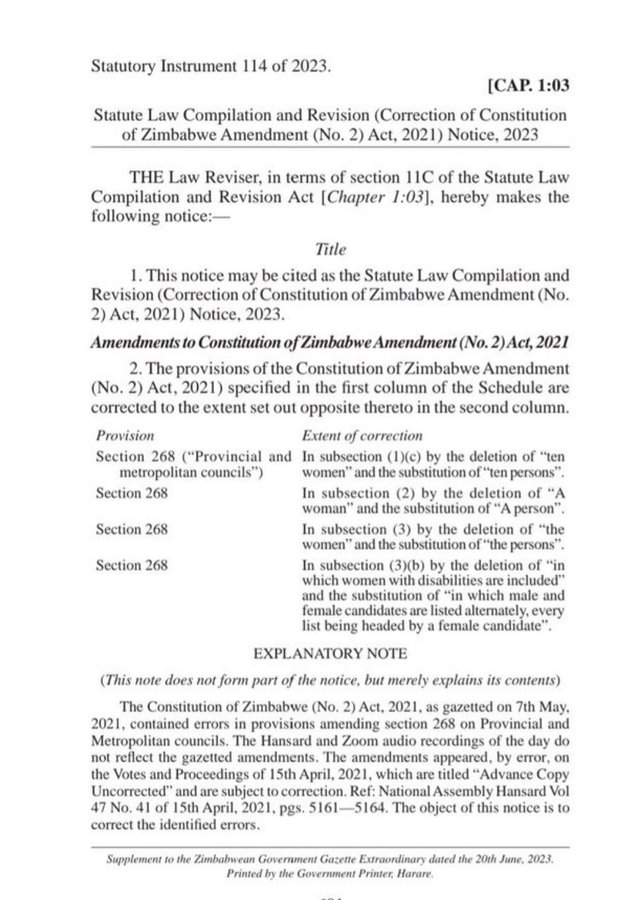
The first amendment occurred the day before Nomination day on the 20th June when the Government published Statutory Instrument 114 of 2023 amending section 268 of the Constitution. When the Constitution was amended and the amendments published in 2021 it stated that all ten members of Provincial and Metropolitan Councils would be women. The law was signed by Mnangagwa and has been the law of Zimbabwe for some two years. SI 114/2023 seeks to “correct” what it says is a mistake by changing the composition of these Councils from women to women and men. 

It is significant that this amendment was introduced the very day before the nomination courts were meant to sit without prior notice to other political parties.  This meant that at the 11th hour  to parties other than ZANU PF (who would have known about the changes coming), opposition parties had no notice that they needed to prepare lists for these Councils (voted in by means of proportional representation) of both women AND men.

But aside from the discrimination and prejudice that these last minute changes to the Constitution produced, the fact remains that they are brazenly illegal and unconstitutional. 

Section 328 of the Constitution sets out a detailed procedure which must be followed before the Constitution is amended in any way. Whilst SI 114 purports to be a “correction” the plain facts show it amends a Constitutional provision which had been in force for almost two years. It is illegal to amend the Constitution by a Statutory Instrument which is not provided for in section 328 of the Constitution. 

In addition, section 157(5) of the Constitution states  that “after an election has been called, no change to the Electoral Law or to any other law relating to elections has effect for the purpose of that election”. In other words no changes to any Electoral law can have any effect on this year’s election if promulgated after the date when the election was called, namely the 31st May. Despite these brazen illegalities ZEC went ahead and insisted that the Proportional Representation lists for Provincial Councils be comprised of both women and men.

Finally, section 68(1) of the Constitution states that every person, which incudes Zimbabwean political parties, has a right to “administrative conduct that is lawful, prompt, efficient, reasonable, proportionate, impartial and both substantively and procedurally fair”. Introducing a change to the Provincial Council lists less than 24 hours before nomination day, where the “error” has been in place for nearly two years, is not “prompt, efficient, reasonable or proportionate”. Introducing these changes in a manner in which only one party, ZANU PF, has prior knowledge of the changes is not “impartial and both substantively and procedurally fair”. 

Amendment regarding receipt of postal ballots

The second amendment to an electoral law was done through Statutory Instrument 140A which purports to change the time, set out in section 75(1)(d) of the Electoral Act, when postal ballots are to be received by Chief Elections Officers in different constituencies from 14 days prior to the poll to 3 days prior to the poll. Ironically this was prompted by the spurious cases brought at the behest of ZANU PF seeking the nullification of CCC MPs’ and Kasukuwere’s nominations, which delayed the printing and distribution of ballot papers.  Whilst ZEC purported to amend the Electoral Act in terms of section 192(4) and (5) of the Act (which gives power to ZEC to make regulations) the fact remains that that section is subject to section 157 (5) of the Constitution which prohibits any changes to the Electoral law after the election has been called.

Presidential candidate Kasukuwere challenged ZEC’s action in this regard but in another of a long line of poor decisions by the Courts, the case was dismissed. Although a full judgment in the case has not been issued it is hard to conceive how any High Court Judge could have found a way around the clear dictates of section 157 (5) of the Constitution. 

6. Unfair and illegal distribution of State resources and Political Parties Finance Act funding

Illegal disbursements in terms of the Political Parties Finance Act

As mentioned above Zimbabwe’s Political Parties Finance Act allows the State to fund political parties in proportion to the percentage of votes received in the previous election. In 2018 ZANU PF received 70,03 % of the votes cast in the Parliamentary election (which is used to calculate the funding rather than votes cast in the Presidential election) and the MDC Alliance received 29,97 %. The MDC T fell below the threshold contained in the Act (less than 5 % of the vote) and so was not entitled to any funding. 

In May 2019 the MDC Alliance held a Congress in Gweru. Chamisa was elected President. Douglas Mwonzora was not elected at that Congress to any substantive position and he subsequently resigned from the MDC Alliance and rejoined the MDC T, becoming its President in December 2020. Although Mwonzora spuriously claimed, with the support of ZANU PF, in early 2022 that he was also the leader of the MDC Alliance, on nomination day, the 21st June 2023, he stood as Presidential candidate for the MDC T party, not the MDC Alliance. Although he subsequently withdrew (at the same time calling for a boycott of the election), his name still appeared on the Presidential ballot under the party name of MDC T. It is also noteworthy that the MDC T it didn’t nominate a single MP candidate.

On Friday 7th July the Minister of Justice issued General Notice 1153 purporting to disburse Z$ 1 billion to ZANU PF and the MDC Alliance parties. ZANU PF was allocated Z$ 700 million and the MDC Alliance Z$ 300 million. However the Z$ 300 million allocated to the MDC Alliance was paid to the MDC T party in flagrant violation of the Political Parties Finance Act. Although the CCC by its own admission is a different party to the MDC Alliance (and therefore doesn’t lay claim to the money notwithstanding the fact that the MDC Alliance was clearly led by Chamisa, something confirmed in the May 2019 Congress)  there were no possible legal grounds permitting the payment of any money to the MDC T party. The disbursement of Z$ 300 million to the MDC T is plainly illegal and was calculated by ZANU PF to fund an ostensibly rival opposition party capable of drawing votes away from the CCC. 

Questionable sources of election funding by ZANU PF

Whilst it is hard to prove that ZANU PF has relied on illegal sources of funding, given the sheer magnitude of their expenditure in the election questions must arise regarding the legality of its funding sources. In the run up to the election ZANU PF purchased brand new luxury 4 x 4 twin cab vehicles for each of its 210 Parliamentary candidates and scores more for its party structures. These vehicles alone must have cost ZANU PF at least some US$ 18 million. ZANU PF literally has more new vehicles this election to campaign with than the police have to police the election with. To bolster numbers of people attending its rallies it  employed a fleet of some 400 buses and 100 trucks to ferry thousands of supporters across Zimbabwe to every rally addressed by Mnangagwa. Those attending these rallies were fed and provided with a vast array of regalia. In other words millions of US dollars were spent at every rally.

Whilst election spending of this magnitude is common throughout the world, and therefore normally something which should not raise eyebrows, in the context of the collapsed Zimbabwean economy and the significant disparity between this spending and the spending of all other political parties, including the CCC, it should be a matter of concern, particularly when viewed in the light of the money laundering scandal exposed by Al Jazeera in its #Goldmafia series which commenced showing on the 23rd March 2023. In the third episode of that series, screened on the 6th April 2023, Mnangagwa’s Ambassador-at-large and Presidential Envoy (appointed by Mnangagwa in March 2021) Prophet Uebert Angel said : 

His (Mnangagwa) election, I think they are spending like US$240 million and that is his money.” 

It is noteworthy that in this election most of the ZANU PF branding on its vehicles and election paraphernalia was focused on Mnangagwa rather than the party itself, which itself raises questions about where the source of the funding has come from.

Two legal issues arise from this. Firstly, is the source of funding legal? Given that  Mnangagwa’s own Envoy stated publicly that Mnangagwa would be putting some US $240 million of his own money into the election campaign what is the source of that funding, particularly given the fact that Mnangagwa has been a Cabinet Minister since 1980 and his only apparent alternative source of income is from his farming activities? Is it possible that the source of  ZANU PF’s election funding comes from international crimes, including money laundering? 

Secondly, section 93 of the Electoral Act sets out clearly what election expenses are lawfully permissible. It is a remarkably restrictive law which does not allow or envisage expenses on the scale seen in this election. It does not allow, for example, purchases of hundreds of vehicles to promote one candidate, nor the bussing of thousands of supporters. Furthermore the selective application of the law by ZEC is illustrated again in this section of the Act. Whilst on the one hand ZEC dramatically increased the nomination fees for MPs from US$ 50 to US $1000, with the clear intention of prejudicing lesser funded candidates, it took no steps to prescribe a limitation of campaign expenditure as envisaged by section 93 (h) of the Electoral Act, which is clearly designed to put a cap on electoral expenditure in the interests of fairness. In failing to prescribe a cap, whilst at the same time dramatically increasing nomination fees, ZEC has breached its obligations set out in section 238 (a) of the Constitution to ensure that elections are conducted “freely, fairly and transparently’. ZEC has taken no steps to investigate the source of ZANU PF’s excessive expenditure, particularly in light of the assertions of Prophet Uebert Angel in April, which have now come to pass. 

7. Gross breaches of section 61(4) and section 155(2) of the Constitution by State media

Section 61(4) of the Zimbabwean Constitution states that 

“All State-owned media of communication must—

(a) be free to determine independently the editorial content of their broadcasts or other communications;

(b) be impartial; and

(c) afford fair opportunity for the presentation of divergent views and dissenting opinions.”

This is particularly important in a country like Zimbabwe where there is only one TV station, the State controlled ZBC, and no genuinely independent radio stations (all the nominally private radio stations have some connection to ZANU PF) and all the dominant broadsheets, The Herald, The Chronicle, The Sunday Mail and the Sunday News are effectively State owned (whilst there is a trust which owns these papers in reality the trust is controlled by the State). Although social media is widely used by young people in urban areas, most rural people do not have smart phones and have limited access to the internet.  Because of this, their primary source of information remains state controlled radio.  

Furthermore section 155(2)(d) of the Constitution says that the State must take all appropriate measures to provide contestants in an election with “fair and equal access to electronic and print media, both public and private”.

As the respected legal NGO Veritas states “the Constitutions provisions are broad and general.  Part XXIB of the Electoral Act fills in some of the details.  The relevant sections in the Part include:

·      Section 160G, which obliges public [i.e. State-controlled] broadcasters to give all political parties and candidates such free access to their broadcasting services as may be prescribed” – i.e. as may be prescribed in regulations made under the Electoral Act.  No regulations have been made under the Act requiring public broadcasters to give free access to parties and candidates, however, and in practice such access is not given.

·      Section 160H, which says that although news media are not obliged to publish political advertisements, if they do they must accept advertisements from all political parties on the same terms.

·      Section 160J, which lays down rules of conduct for news media, public as well as private, during election periods:

Their coverage of all political parties and candidates must be equitable

Their election reporting must be factually accurate, complete and fair

They must distinguish clearly between factual reporting and editorial comment

They must correct inaccuracies without delay and must give parties and candidates a reasonable right to reply

They must not promote parties or candidates that encourage violence or hatred against any Zimbabweans, and

  • They must avoid language that encourages prejudice, hatred or violence or is likely to lead to undue” public contempt towards a party or candidate.

It is obvious to any objective person watching the ZBC or reading, for example, the Herald that there have been flagrant and consistent breaches of the Constitution and the Electoral Act which the ZEC did nothing to stop despite its obligations to do so. The ZBC, the Herald , the Sunday Mail and the Chronicle consistently vilified Chamisa and the CCC; they downplayed and distorted reporting on the numbers of people attending CCC rallies. Despite the fact that CCC and ZAPU were the only parties to produce a manifesto, there was no attempt to give any opportunity to the CCC or ZAPU to explain its manifestos. This is all the more remarkable given that ZANU PF didn’t even produce a manifesto. In short the ZBC and main broadsheets mentioned were brazenly been used as propaganda vehicles for ZANU PF, in breach of the Electoral Act.

In this regard Veritas’ comment published on the 17th August is apposite:

“The Zimbabwean news media, both public and private, have been persistently and at times outrageously partisan in their coverage of this years election.  For the public news media this partisanship is an obvious violation of the law, in particular section 61(4) of the Constitution and section 160J of the Electoral Act, but the private media are also required to be fair and accurate.  They too have violated the law.

There are other violations as well:

·      Parties and candidates have not been provided with equal access to the media, both public and private, as required by the Constitution and the Electoral Act.  Although the Electoral regulations which we mentioned above say that access need only be equitable, i.e. fair, rather than equal, section 155 of the Constitution and para 2(1)(f) of the Fourth Schedule to the Electoral Act say that access must be both fair and equal.

·      Parties and candidates have not been allowed free air time by public broadcasters to give political party broadcasts.  Although section 160G of the Electoral Act does not say so expressly, it implies that all parties and candidates contesting an election must be given some free air time, the amount to be prescribed in regulations – which means that even though no regulations have been made, the public broadcasters should have given parties at least some free air time to address the electorate.

·      ZEC has not set up a committee to monitor media coverage of the election, as it is obliged to do by section 160K of the Electoral Act.  If the committee had been set up and its findings published on a weekly basis, media partisanship might have been more restrained and some of the worst excesses avoided.”

It goes without saying that a fundamental element of any free, fair  and credible election must be the ability of the electorate to understand what the various parties and candidates stand for. They also need truthful and accurate reports about the electoral process. This election has not come any where close to meeting Zimbabwe’s own Constitutional and Electoral Act requirements, never mind international standards.  

8. Obstacles placed in the way of Election Observers and Journalists 

 At the same time ZEC legislated a dramatic increase in nomination fees, on the 19th August 2022, it also increased fees payable by foreign observers through SI 143/22. The fees (which have always been in US currency and therefore not susceptible to inflation to the same extent as fees chargeable in Zimbabwe dollars) increased by between 100% and 600%.  For example fees for observers “invited from Africa” increased from US$ 20 to US$100, observers from “non-African Embassies” from US$ 50 to US $300 and general observers from “non-African countries” from US $ 100 to US $ 400. Soon after these fees were introduced the legal think tank Veritas opined that the fees were illegal because they were for an “improper purpose” (in that they were intended to prevent people from doing what the law allows them to do), “ so high to be grossly unreasonable”, “discriminatory” and in breach of both section 67 of the Constitution and the preamble to the African Charter on Democracy, Elections and Governance and the SADC Principles and Guidelines on Elections, both of which “emphasise the importance of independent observers in ensuring that elections are transparent, credible and democratic”. 

Veritas’ warning that the fees were intended to discourage foreign observers from attending the elections, and that they would in fact discourage foreign observers from attending, did in fact happen, with relatively small delegations coming to observe the elections. 

But that situation has been further compounded by the fact that ZEC cherry picked observer missions and the government sought to cherry pick which journalists were accredited. An example of government interference regarding the composition of observer mission teams was its action in declining to approve people like Larry Garber of the Carter Center, apparently because he made negative comments regarding Zimbabwe 2018 elections.  

In addition numerous journalists have either had their accreditation applications refused or delayed. Journalists from the South African paper Daily Maverick were refused as were journalists from the London Sunday Times, New York Times and CNN. In July Nigerian journalist David Hundeyin was deported from Zimbabwe after immigration authorities queried his arrival without a visa. Other journalists, for example, some from CNN, were accredited but several journalists for these same international media organisations, who have been covering Zimbabwean elections for years, and who have a detailed knowledge of the country, were denied accreditation, or their applications were not responded to in time to travel to Zimbabwe. This appeared to be a deliberate policy designed to stem the flow of negative stories which would expose the real nature of the elections.

In a similar manner in the last few days leading up to the election several professional people were summarily deported from Zimbabwe. The most high profile example of this was the deportation of former Chief Operations Officer of the South African Broadcasting Corporation and SADC Executive Director of Good Governance Africa, Chris Maroleng, of Thursday the 17th August. Finally on Sunday 20th  August Professor Stephen Chan (aged 73) was arrested on arrival at Harare airport and deported. Chan, who is Professor of World Politics at SOAS, University of London, was bizarrely alleged by the state controlled Herald newspaper to have been deported because he “planned to train opposition insurgents”. His real crime is that he has commented negatively for several years regarding the ZANU PF’s government’s performance since 2018. The fear appears to be that because of his detailed knowledge of Zimbabwe he might report accurately on what he observed. 

Election day breaches 

1. Sections 134(3) and 147(1) of the Electoral Act – setting up of “Exit poll surveys” by ZANU PF

Soon after polling started on the 23rd August 2023 it emerged that ZANU PF had set up so called “Exit poll survey” desks manned by at least two people and branded “ZANU PF” within the proximity of most polling stations countrywide. Many, if not most, were located within 300 meters of polling stations. Credible reports were received countrywide of people, particularly in rural areas being asked to provide their names and ID numbers to these stations before and after they voted. In many polling stations reports were made to police that they be removed and at the very least moved beyond the 300 meter radius of polling stations as prescribed by section 147(1) of the Electoral Act. In urban areas many of these desks were moved beyond the 300 meter radius, or shut down completely. In most rural areas the tables continued functioning all day.

These desks, whether inside the 300 meter radius or outside of it, are illegal. Section 134(3) of the Electoral Act states:

“Any person who by abduction, duress or threats or by fraudulent device or contrivance—

(a) impedes or prevents the exercise of his or her vote by a voter; or 

(b) compels, induces or prevails upon a voter either to vote or to refrain from voting at an election;

shall be guilty of the offence of undue influence and liable to a fine not exceeding level seven or to imprisonment for a period not exceeding two years or to both such fine and such imprisonment.”

Section 147(1) of the Electoral Act states 

“(1) Without derogation from any other provision of this Act or any other enactment, no person shall, within three hundred metres of any polling station on any polling day—

(a) convoke or take part in any gathering of more than twelve persons; or

(b) canvass for votes; or

(c) utter slogans; or

(d) distribute leaflets or pamphlets for or on behalf of any candidate or political party; “

ZANU PF flagrantly violated both of these laws on election day. The setting up of these tables was clearly a “contrivance” which were designed to “impede” the free “exercise of (a) vote” or which “compels, induces or prevails on voters to vote”. The suggestion that they were “exit polls” is simply a cover, a contrivance, designed to induce voters to register their names at a desk, with, in turn, the intention of compelling voters to vote for ZANU PF, and not to vote for any other party. Any suggestion that this was an “exit poll survey” is dismissed simply by the fact that at many of these desks voters were asked to give their names prior to voting. Despite reports made to ZEC no action by ZEC was taken nationally to shut the desks down.

Furthermore the desks were all covered with highly visible,  pre printed and organised tablecloths (in other words manufactured centrally and uniformly printed) which clearly bore ZANU PF’s logo and name. There are widespread reports and videos of long lines of people (well in excess of 12 people at any one time) gathered to register their names at these desks. As stated above many, if not all, of these desks were situated within 300 meters of polling stations when polling started. The purpose of the desks were clearly to canvas for votes and in many instances routinely resulted in gatherings of more than 12 people at a time. The use of the words “exit poll survey” was just a thinly disguised phrase used to cover an operation designed to canvas for votes within close proximity to polling stations right across the country. As stated above despite formal complaints (and in at least one instance a lawyer’s letter demanding enforcement of the law) ZEC did nothing to enforce the law.

2. Section 148 – publication, printing and distribution of illegal and fraudulent flyers 

Overnight, prior to the opening of polls, in several cities throughout Zimbabwe tens of thousands of flyers were distributed which bore the CCC yellow colour, CCC logo and Chamisa’s face with the words “DO NOT VOTE – ELECTION IS RIGGED – ELECTION IS STOLEN”. They were deliberately scattered around numerous polling stations in all major cities. The cost of printing these must have run into thousands of US dollars. The cost and quality of the flyers and their coordinated widespread distribution overnight point to this being organised by an institution with access to considerable money and resources. The clear intention of the flyers was to induce in the minds of urban voters that Chamisa had withdrawn from the election and that there was consequently no need to vote. The main institution which could have benefitted the most from this was ZANU PF and its Presidential candidate. The flyers had the effect of confusing thousands of urban voters on the morning of the poll. Numerous reports have been received of that confusion including some in which voters no longer voted. For the avoidance of doubt Chamisa did not call for a boycott of the election. Although the CCC and Chamisa himself have criticised the illegalities which have plagued this election no boycott was ever contemplated or called. 

Section 148 (2) of the Electoral Act states:

“Any person who, before or during an election, publishes a false statement of the illness, death or withdrawal of a candidate at that election for the purpose of promoting or procuring the election of another candidate, knowing that statement to be false or not knowing or believing it to be true, shall be guilty of an illegal practice and liable to a fine not exceeding level five or to imprisonment for a period not exceeding six months or to both such fine and such imprisonment.”

These flyers were clearly false published statements which were intended to suggest that Chamisa had withdrawn as a candidate in the hope that urban people (who overwhelmingly support Chamisa as demonstrated in the results announced thus far) would not vote. The intent was clearly to “promote the election of another candidate”, namely Mnangagwa, by sowing confusion in the urban electorate and deterring CCC and Chamisa supporters from voting.

Both ZEC and the Police throughout the country were made aware of these fliers. No attempt was made, or has been made, to investigate and prosecute those who had these flyers printed and distributed. 

3. Delays in starting the election. Breaches of sections 155(1)(a)  and (2) (c) as read with sections 236 (1) (a), (b) and (c) section 68 of the Constitution – Orchestrated chaos

It is now common cause that ZEC failed to distribute ballot papers to numerous constituencies in Harare, Bulawayo and Manicaland, all areas where CCC has significant support in time for voting to commence at 7 am on the 23rd August. In numerous constituencies in these three provinces voting only began late in the day, in some cases as late as 8pm that evening. In some cases polling stations remained open until the early hours of the 24th August. Arguably thousands of people were deterred from voting in these Constituencies. Whilst at the time of writing this report no detailed analysis has been possible of voter turnout it is possible, indeed likely, that voter turn out was reduced in these areas.

 ZEC gave the excuse that this was because there had been delays in the production of ballots, and sought to blame the numerous court applications regarding the nomination of candidates which delayed the printing of the ballots. Aside from the fact that ZANU PF itself initiated both the case against the Bulawayo 12 MPs and the case against Saviour Kasukuwere, the excuse given by ZEC makes no logical sense. The main ballot which was delayed was the Presidential ballot which was held up by the Kasukuwere case and yet that ballot was delivered countrywide on time, including the most remote polling stations which all opened on time. The Bulawayo 12 MP case only affected Bulawayo MPs and those ballots were all delivered on time. It appears the main, if not only, ballots which were not delivered on time were the local council ballots. Intriguingly once again there was no delay in the delivery of local council ballots to the most remote polling stations. In contrast local council ballots were not delivered in Harare on time and in some cases over 12 hours late, and yet presumably these ballots were printed in Harare. The excuse given by ZEC simply does not stand up to close scrutiny.

On 16th August 2023, the Chairperson of ZEC, Judge Chigumba, told election observers at a briefing that ZEC was ready to deliver “free and credible elections with most of the logistical arrangements now in place”, which was reported in the Herald newspaper on 17th August.  As mentioned in the SADC Electoral Observation Mission preliminary statement, ZEC had assured the SADC observer mission and other missions that all necessary voting papers including ballot papers were ready for use.  As mentioned in the African Union and COMESA election observation preliminary statement on 21st August 2023, ZEC reported that “98% of all preparations were done and election materials had already been delivered to the polling areas”.  In view of these assurances, it is inexplicable that suddenly the ballot papers were not available.  

The fact of the matter is that these significant delays in getting voting underway mainly, if not exclusively, occurred in constituencies which have traditionally voted heavily for the opposition. The obvious conclusion is that this was orchestrated chaos devised by ZEC with the clear intention of reducing the number of people who would vote for the CCC and Chamisa in their strongholds.

Section 155 (1)  (a) states:

“Elections, which must be held regularly, and referendums, to which this Constitution applies must be—

  1. peaceful, free and fair”

Sections 155 (2) (b) and (c) state:

“The State must take all appropriate measures, including legislative measures, to ensure that effect is given to the principles set out in subsection (1) and, in particular, must—

(b) ensure that every citizen who is eligible to vote in an election or referendum has an opportunity to cast a vote,

(c) ensure that all political parties and candidates contesting an election or participating in a referendum have reasonable access to all material necessary for them to participate effectively;”

Sections 236 (1) (a), (b) and (c) state:

“Members of the independent Commissions (including ZEC) must not, in the exercise of their functions—

(a) act in a partisan manner;

(b) further the interests of any political party or cause;

(c) prejudice the lawful interests of any political party or cause;”

Section 68 of the Constitution states:

“Every person has a right to administrative conduct that is lawful, prompt, efficient, reasonable, proportionate, impartial and both substantively and procedurally fair.”

All of these fundamental Constitutional provisions were deliberately flouted by ZEC to favour ZANU PF over CCC. ZEC had an obligation to deliver all voting materials to all polling stations at the same time in a manner which did not prejudice or favour one political party over another. Bearing in mind that in 2018 Mnangagwa, according to ZEC’s own figures, only overcame the burden of securing a 50% plus one majority by some 28,000 votes (in an election in which almost 5 million votes were cast), it can be seen that the failure by ZEC to deliver ballots on time to these CCC strongholds has the ability to have a material effect on the outcome of the election, aside from the fact that it violated rights which are sacrosanct in any democracy.

It obviously cannot be proved that ZEC did this deliberately but the only reasonable inference is that it did so. Whether or not it was deliberate only aggravates the conduct but does not eliminate the breach which in itself would be sufficient to invalidate the entire election before any professional, independent and competent court.

Events post the election

Detention of ZESN staff alleged breach of section 66 A

On the night of Wednesday 23rd/Thursday 24th August some 43 civic society workers, most working for or with the Zimbabwe Electoral Supervisory Network and the Election Resource Center were arrested by Police at the Holiday Inn in Harare on allegations that they had breached section 66  A of the Electoral Act. At the same time they were arrested some 93 smartphones, 38 laptops and a variety of other equipment were seized by the Police. 

On the afternoon of the 25th August those arrested were arraigned before the Magistrates Court having spent a night in detention.

Section 66 A of the Electoral Act states:

“(1) Subject to subsection (3), any person who—

  1. purports to announce the result of an election as the true or official results; or (b) purports to declare any candidate to have been duly elected;

before an electoral officer, acting in accordance with this Act, has announced the result of that election or declared a candidate to have been duly elected in that election, as the case may be, shall be guilty of an offence and liable to a fine not exceeding level five or to imprisonment for a period not exceeding six months or to both such fine and such imprisonment.

(2) Subject to subsection (4), any person who, with intent to deceive or to discredit the electoral processes in an election, falsely—

(a) reports or announces the number of votes received by a candidate or political party in an election; or

(b) declares any candidate to have been elected in an election;

shall be guilty of an offence and liable to a fine not exceeding level six or to imprisonment for a period not exceeding one year or to both such fine and such imprisonment.

(3) Subsection (1) shall not be construed as preventing any person from reporting the number of votes received by a candidate or political party in an election, where the report is based on polling-station returns and constituency returns from the election concerned.”

It is clear that these civic leaders were working openly from a public place, a hotel, and acting completely within their rights to gather and collate information and to report on the same (as they are entitled to do in terms of the Constitution and in terms of section 66 A (3) ). There is nothing unlawful about anyone who wishes to gather information released by ZEC itself (namely V11 and V 23 forms), to analyse the same and then to report on it. There is no evidence that they had any intention to make an announcement of the results. 

If anything this points to the government seeking to prevent objective analysis and reporting of the results. The seizing of all the equipment used in this exercise appears to be designed to ensure that whatever information has been obtained cannot be used to question any results announced by ZEC. If the whole electoral process is lawful and transparent one wonders why there should be such a heavy handed and unlawful action taken to detain people.

This is also another example of the law being used by ZEC, acting in concert with the Police, to selectively use clauses of the Electoral Act to clamp down on rights rather than protect them. The heavy-handed action stands in marked contrast to the conduct of both ZEC and the Police in turning a blind eye to brazen breaches of the law by ZANU PF on the election day itself, and after the election when senior members of ZANU PF themselves purported to announce in a press conference the results claiming that ZANU PF had won a two thirds majority in Parliament and that Mnangagwa had won the Presidential election.

What standard should be used to determine “credibility”? 

This is, by some considerable margin, the most illegal election Zimbabwe has ever held. Never before have there been so many deliberate  breaches of Zimbabwe’s Constitution and Electoral Act by several government institutions. All of the breaches have been done to benefit one party, namely ZANU PF, and one candidate, namely Mnangagwa.

To return to the original question of whether these elections are “credible”, the answer to that question lies in Zimbabwe’s location, namely Southern Africa, and its membership of SADC.  As mentioned above, SADC specifically has the SADC Principles and Guidelines on Elections which Zimbabwe is bound to comply with. In addition there are the standards which have been set by all of Zimbabwe’s immediate neighbours and countries in the region which it has long standing historical, economic and cultural ties with, such as Malawi, Lesotho and Nambia. These are the standards which should be used to judge whether or not Zimbabwe’s elections are credible.

There are four areas in which Zimbabwe’s electoral environment is fundamentally different, and substantially worse, than the conditions which prevail in any of its neighbours, and indeed in an overwhelming majority of countries in SADC.

  1. Judiciary

This paper sets out in detail how the independence of the judiciary has been compromised  in the last few years, but particularly in the current election. There is clear evidence of this in the way the Courts have handled the detention of opposition leaders (particularly when compared to the way the Courts have handled members and supporters of ZANU PF) and in the manner that the vast majority of election related cases have been handled. 

This stands in marked contrast to the independent courts in South Africa  and the conduct of the judiciary in electoral cases throughout the region which have tried to uphold respect for the rule of law. The most significant recent case was the Constitutional Court judgment handed down in Malawi on the 3rd of February 2020 nullifying the election President Peter Mutharika won in May 2019, citing massive irregularities during the process. The verdict resulted from a court challenge filed by Saulos Chilima, leader of the opposition United Transformation Movement Party, and Lazarus Chakwera, leader of the Malawi Congress Party. The court called for fresh elections within 150 days and the judgment was subsequently upheld on appeal to the Malawian Supreme Court. This ultimately resulted in the opposition leader Lazarus Chakwera assuming office. It is hard to imagine something similar happening in Zimbabwe at present, particularly following the reported offer of US $ 400,000 loans being made to Judges. 

2. Media

In stark contrast to the regional standard Zimbabwe does not have a single independent TV station, nor does it have any genuinely independent radio stations. As mentioned above the State owned or controlled electronic media organisations have brazenly violated their Constitutional obligations in terms of section 61 (4) of the Constitution.

In all the countries neighbouring Zimbabwe there are a plethora of independent TV and radio stations and rights of freedom of expression are fully respected, particularly during elections.

3. Oppressive legislation

Zimbabwe has two pieces of legislation, namely the Maintenance of Peace Act and the so called Patriot provisions in the Criminal code which are unique to Zimbabwe. As recognized in the SADC Electoral Observation Mission’s preliminary statement, the Patriot Act ‘has resulted in a severe restriction of the freedom of expression which is guaranteed by section 61(1) of the Constitution’.  Both pieces of legislation severely undermine fundamental freedoms. No similar legislation exists in any other country in Southern Africa.

4. Diaspora vote

Although the Constitution states that every Zimbabwean citizen over the age of 18 has the right to be registered as a voter and to vote (in section 1 of the Fourth Schedule as read with section 67) this right has not been respected and hundreds of thousands of Zimbabweans in the diaspora have been disenfranchised. In the current election none of these Zimbabweans were able to vote.

The refusal to respect the right of all Zimbabweans to vote also stands in marked contrast to the standard set in all Zimbabwe’s neighbours, where all the citizens of Botswana, Mozambique, Zambia and South Africa  are entitled to vote irrespective of their place of residence. 

Conclusion 

The SADC Electoral Observation Mission’s preliminary statement issued by its Head of Mission His Excellency Dr Nevers Mumba on the 25th August concludes by stating that 

“some aspects of the Harmonised Elections, fell short of the requirements of the Constitution of Zimbabwe, the Electoral Act, and the SADC Principles and Guidelines Governing Democratic Elections (2021)”.

Accordingly the SADC Observer Mission itself has acknowledged that the 2023 elections breached Zimbabwe’s Constitution, the Electoral Act and SADC election principles. It is gratifying that the statement sets out some of the laws which have been breached and condemns these breaches. This paper touches on those breaches but in addition raises other breaches of law which the Mission statement did not mention. 

Those who may wish to judge the 2023 Zimbabwean elections by a lower standard than SADC itself adheres to should consider the ramifications of such a move. Aside from disrespecting what the regional body itself has determined, the message which will be sent is that a lower standard will be acceptable in future. There are green shoots of democracy sprouting throughout Southern Africa which auger well for stability and long term economic growth, development and opportunity. But there are also undemocratic forces in Southern Africa who are keen to either retain power, or acquire it, by undemocratic means. If the high standards espoused by the SADC Mission are not supported by other Nations and Institutions then they will undermine the entire region and play into the hands of undemocratic forces.

It is naive to think that any group of people who acquired power through a violent and illegal coup d’etat in 2017 will now willingly relinquish that power through a lawful election. The danger for the entire region is that if a blind eye is turned by the international community to brazen electoral illegalities committed by  the same group of people responsible for the 2017 coup d’etat it will set a new and dangerous precedent for governance in the entire region. Tyrants will view that as licence to disregard their own Constitutions and laws with the sole objective of retaining power. That in turn will destabilise the entire Southern Africa region. 

There is one final point which is of continental and global importance. For 23 years Chamisa and the opposition have waged a non violent democratic struggle against a tyrannical regime. In the last few years they have survived an unprecedented assault designed to destroy the main opposition party in Zimbabwe. The reason ZANU PF has had to resort to the illegal measures outlined in this paper is because Chamisa and the CCC, far from being destroyed, have enjoyed growing support and momentum DESPITE all that has been thrown at them and the fundamental breaches of law. That has been achieved using non violent, democratic, means. The democratic world should reward that by joining SADC in its condemnation of the election. Zimbabwe and Africa deserve better irrespective of who is declared the winner of the election. 

Posted in Blog | Leave a comment

Pan-African Parliament slammed for appointing alleged gold smuggler and money launderer as religious ambassador

Daily Maverick

19th July 2023

By Peter Fabricius

The African Union has been condemned for reportedly allowing its Pan-African Parliament to appoint the Zimbabwean “prophet” Uebert Angel, recently exposed as a gold smuggler and money launderer, as its ambassador for interfaith dialogue and humanitarian affairs.

The independent Zimbabwean radio station Nehanda Radio reported that it had been unofficially informed of the appointment.

“Ambassador Angel’s extensive knowledge, influential network, and commitment to fostering unity among diverse religious communities is what saw him emerge as an ideal candidate for this vital role,” Nehanda quoted an anonymous source as saying.

The news organisation Al Jazeera recently exposed Angel as a key player in a major racket in which a group of money launderers and gold smugglers bribed key members of several South African banks, enabling the crooks to secretly send abroad large amounts of illegally obtained money overseas.

Al Jazeera’s investigative unit posed as criminals seeking help in smuggling gold overseas and secretly filmed several conspirators agreeing to help.

Read more in Daily Maverick: Al Jazeera Gold Mafia exposé ‘tip of the iceberg’ for Zim corruption but accountability remains elusive

Angel, a self-proclaimed prophet, was recently appointed by Zimbabwean President Emmerson Mnangagwa as Zimbabwe’s ambassador-at-large for Europe and the Americas. Al Jazeera’s clandestine footage included Angel agreeing to smuggle $1.2-billion of dirty cash into Zimbabwe using his diplomatic status.

Daily Maverick asked Pan-African Parliament spokesperson Jeffrey Onganga to comment on the allegations. He did not confirm or deny that Angel had been appointed to the position, but only said, “There’s no official statement from the Pan-African Parliament to this effect.”

Veteran Zimbabwean politician and lawyer David Coltart, a former senator and education minister, said: “This is obviously a very serious development. Allegations have been levelled against Prophet Angel which have not been rebutted, which have not been adequately investigated by the Zimbabwe police.

“They have already had a devastating impact on Zimbabwe’s financial system with some of our commercial banks struggling to get correspondent banks internationally because Zimbabwe is now associated with money laundering on a grand scale and the allegations levelled against Angel linked him to very senior people in government and the Reserve Bank of Zimbabwe.

“And for the African Union to simply ignore this is a serious indictment against it. And it is also an indictment against them regarding the particular role which is envisaged. Prophet Angel holds himself out to be a Christian leader and yet what he is accused of is anathema to the Christian faith and to everything that Jesus Christ taught and stood for.

‘An indictment against AU’

“And so it’s hard to understand how this man can be chosen for this particular role. There are thousands of Christian leaders throughout Africa, people of great integrity who would be far better suited for this job. So this is an indictment against the African Union.”

Coltart continued: “It’s very important to understand how he got this position. I suspect we will find that it is due to intense lobbying by Zanu-PF to get him into this position, deliberately. Not just to get influence at that body but also to give them cover against the very serious allegations which have been levelled against Angel but also against senior Zanu-PF officials. I’m sure that the thinking is if the African Union endorses this man, then that will whitewash the very serious allegations against senior Zanu-PF leaders.”

Read more in Daily Maverick: ‘Sad day for Zimbabwe’ as Mnangagwa passes ‘draconian’ law to silence critics ahead of August poll

The Speaker of the Pan-African Parliament is Fortune Charumbira, the president of the Zimbabwe Council of Chiefs and a former deputy minister in the Zanu-PF government.

Prominent Zimbabwean investigative journalist Hopewell Chin’ono announced on Twitter that he would be broadcasting Al Jazeera’s Gold Mafia documentary series “so that Africans can see the shame that the African Union and Pan-African Parliament have brought to this continent by appointing a self-confessed gold smuggler and money launderer as an AU Ambassador.

“With that shameful appointment, Africa has lost any legitimacy to good governance or any pretence to fighting corruption.

“Today I broadcast the Gold Mafia Episode 1, featuring the new Pan-African Parliament’s ambassador, Uebert Angel Mudzanire, who has been implicated in fraud, money laundering, racketeering and gold smuggling,” Chin’ono said.

“This is why life is so difficult for Africans outside Africa — we are all seen as crooks because of the actions of these few corrupt politicians. We must stand for something, we must have basic values and not allow this criminality to be rewarded in our name.” DM

Posted in Blog | Leave a comment

Coltart vows to rid Bulawayo City Council of corruption

CITE

19th July 2023

By Tanaka Mrewa

Citizens Coalition for Change (CCC) aspiring Bulawayo Ward 4 councillor David Coltart has vowed to rid the Bulawayo City Council (BCC) of corruption and revert the city to its former glory should he be voted into office. 

Coltart has also been touted as the city’s next mayor.

In an interview on This Morning on Asakhe, a Twitter Space run by CITE, Coltart said he accepted the challenge after being approached by several party members and other political players, requesting him to take up the challenge and try his best to restore the city’s pride and glory. 

“I have been out of government for ten years and I have really enjoyed the break as I have managed to reconnect with my family and friends in the city I love. So, when the party asked me what role I would like to play I said you can put me back into Senate, put my name at the bottom, I know I would not be voted for, but I would have shown my allegiance to the party,” he said. 

“Then some members suggested that I vie for council office and try and restore the dignity of the city. Some people, even those from other parties-not Zanu-PF of course, said why don’t you go into council and restore the city pride. So, because of those requests, I have agreed to stand in as councillor for Ward 4. I viewed that as a poisoned chalice because there would be very high expectations and they would be very difficult to meet.” 

Responding to reports of him likely to land to mayoral position, Coltart said he was not getting ahead of himself.

“There is a lot of talk about me being mayor. I am not counting those particular chickens before they hatch. There is a process, I must be elected as councillor for Ward 4, the CCC will have to have a majority number of councillors and then I would have to secure the support of other councillors to become mayor. It is a long road to travel in that regard, so I am not making any assumptions in that regard,” he said. 

He said his vision of the city is to rid it of corruption in order to attract more investments. 

“If I am to sum up my vision for the city, it is to clean up Bulawayo. It has become clear in my mind that one of the reasons why Bulawayo is not working is because of corruption which has become endemic. Bulawayo is not working because of corruption, it is driving away potential investors. I want our city to have more investments and we can do that by eradicating corruption, which has become endemic,” Coltart said.

Posted in Blog | Leave a comment

The Gdansk Declaration: Solidarity for Democracy

From 21-23 June 2023, the European Solidarity Centre and The Brenthurst Foundation staged a conference on ‘Rolling Back Authoritarianism’ in Gda?sk, Poland, the epicentre of political change in Poland and in Europe in the late 1980s. The event was attended by more than 50 leaders from Africa, Latin America, Poland and the Baltic States. At the end of the event, the Gda?sk Declaration was adopted unanimously. It lays out the commitment of all delegates to ending authoritarianism and introducing democracy, accountability and transparency. This is the full text of this historic declaration. The signatories are listed at the end of the document.

The Gdansk Declaration

Solidarity for Democracy

From 21-23 June 2023, the European Solidarity Centre and The Brenthurst Foundation staged a conference on Rolling Back Authoritarianism in Gda?sk, the epicentre of political change in Poland and in Europe in the late 1980s.

This event took place as the world faced new challenges posed by contemporary authoritarian leaders and political systems and increasing assaults on democracy. The delegates were cognisant of the significance of meeting in a country adjacent to Ukraine which is the subject of an aggressive assault on democracy and sovereignty which is unacceptable to all freedom loving peoples.

We recognise that democracy in Africa is already under growing threat, including dramatic reversals this century in the Sahel and in North Africa. While these struggles may be characterised as popular, authoritarianism is today less about promoting ideology than defending elite privilege and power. Some African countries have never enjoyed a peaceful transfer of power at the polls. The weakness of institutions makes African countries particularly vulnerable to external undermining of democracy and to the risks of state capture.

The problem in Africa is not that we have too much democracy, as is sometimes claimed, but not enough.

Since nine out of ten Africans live under versions of authoritarianism, the struggle for democracy must involve all those outside government, in civil society including the media, academia, trade unions, churches and business. It may also involve those in government, given differences between ‘enlightened’ and ‘repressive’ authoritarians.

These struggles are not nationally determined and bound. Defending democracy requires common purpose – of solidarity – among democrats inside and outside all countries. Just as authoritarians have created their own financial, military and media networks that support each other, democrats have to do the same.

And nor are these struggles confined only to Africa. Democrats everywhere are under stress in maintaining these values and corresponding systems.

We accept that there is disillusionment with democracy. This is going to make it difficult to achieve majority governments, and stresses the need for coalitions for democracy on the one hand, and the development of policies that address the concerns of the electorate. Being generally pro-liberty and pro-democracy is not enough always to convince the electorate of the need for sacrifice to defend these values.

We need to promote values at home and abroad. We need not only to learn from the past, but examine our present in strategizing for the future.

We note that those parties which win power at the polls, need to act quickly with this mandate.

But first, democrats need to win the vote at home and to defend this victory. The history of Gda?sk, where the meeting was held, holds valuable lessons for those seeking to build free and open societies.


In 1980, the Gda?sk Agreement, comprising 21 points, reached accord between the government of the Polish People’s Republic and the striking workers of the Lenin Shipyard. Signed in  August 1980 by the government and the strike leader Lech Wa??sa, the Agreement led to the creation of the trade union Solidarity. As such it became an important milestone in the end of Communist rule in Poland and eastern Europe.

Similarly, this contemporary Gda?sk Declaration can be summarised in 21 points describing how oppositions and civil society can roll back authoritarianism and promote peace and democracy in undertaking to:

  1. Support democratic struggles materially and morally, making the fight for democracy easier and safer.

2. Accentuate common interests between opposition groups and seek to find common ground over differences.

3. Commit to shared values and principles, before and after taking power, including transparency, accountability, and key policy precepts such as the protection of private property, and reform of the education and health systems. Act to continuously uphold freedom of speech and association, and basic human rights.

4. Commit to breaking down racial, ethnic, geographical and religious divides in building just, free and fair societies.

5. Establish a region-wide *Alliance of Democrats*, formed around shared values, which meets frequently to build trust, develop joint strategies, monitor electoral standards and practices, and share experiences.

6. Advance a common, clear and consistent narrative to address the needs and fears of the population.

7. Create economies of scale through joint party procurement.

8. Participate in regional election monitoring missions.

9. Defend against state capture by championing the independence of domestic and constitutional electoral agencies, and the judiciary.

10. Develop a common funding platform, internationally sourced and transparently managed, committing to spend 90% of funding raised within the country.

11. Jointly develop and share programmes for post-election reforms, since the goal is not only to remove the regime in power.

12. Call out and manage those corporations responsible for manipulating internet and data coverage.

13. Ensure democracy and transparency in internal processes of governance, and channel support to leaders based on their popularity.

14. Commit to a path for equal gender representation.

15. Expose foreign funding and malfeasance, including disinformation and vote manipulation.

16. Encourage donors to calibrate their support for countries according to their democratic credentials.

17. Guard the capture of the vote and rivals through technology by creating and sharing cyber capacity.

18. Appeal to regional and international leaders and institutions to respond and provide leadership and engage with the opposition especially during times of crisis.

19. Speak on each other’s party platforms, and attend each other’s congresses as special guests.

20. Behave towards each other as fellow democrats, not deadly rivals, and seek those actions which imbue trust.

21. Openly share in, promote and celebrate each other’s successes in opposition as a collective win for African democracy, one election win at a time.

Governments have played a role in dividing opposition and continuing to rule. In so doing they follow a playbook of election malfeasance, including tampering of voter’s rolls and other forms of vote rigging, bribery, manipulation of the media, corruption and intimidation. A strong bloc of opposition groups – within countries and outside – is the best antidote to this, in building their own ecosystems for change and looking out for each other.

We recognise that freedom is not free. Democrats everywhere need to be united, and work together to reduce the costs and risks of this formidable if achievable task. We must provide moral support to all comrades in struggle, from Ukraine to Uganda.

This Declaration offers a collegial and institutional step in that direction.

L?IST OF ATTENDEES AND SIGNATORIES

  1. Abbasali Haji, East Africa Capital, Tanzania
  2. Adalberto Costa Júnior, Leader, UNITA, Angola
  3. Alexander Kambili, Germany
  4. Alfonso de Prat Gay, Former Minister of the Economy, Argentina
  5. Amgad Faried Eltayeb Idris, CEO, Fikra Center for Studies and Development, Egypt
  6. Andriy Marasin, former Senior Assistant Defense Attaché, Ukraine
  7. Anwar El-Sadat, Leadee, Reform and Development Party, Egypt
  8. Arkadiusz Modrzejewski, Director of Institute of Political Science, University of Gdansk, Poland
  9. Artis Pabriks, Former Deputy Prime Minister, Latvia
  10. Atupele Muluzi,  President, United Democratic Front, Malawi
  11. Robert Kyagulanyi “Bobi Wine”, Leader, National Unity Platform, Uganda
  12. Branko Brkic, Editor-in-Chief, Daily Maverick, South Africa
  13. Christopher Clapham, Professor Emeritus,  Cambridge, UK
  14. Cynthia Appenteng, Ellen Johnson Sirleaf Foundation, Liberia
  15. D?avid Coltart, Former Minister of Education, CCC, Zimbabwe
  16. G?eordin Hill-Lewis, Mayor of Cape Town, South Africa
  17. Gloria Uwishema Nsengiyumva, Human Rights activist, All for Rwanda, Rwanda
  18. Greg Mills, Director, The Brenthurst Foundation, South Africa
  19. Gregor Jaecke, Resident Representative, KAS, South Africa
  20. Gregory Nemyria, Deputy Chair, Foreign Relations Committee, Rada, Ukraine
  21. Holger Dix, Konrad Adenauer Stiftung, Germany
  22. Ian Khama, Former President, Botswana
  23. Illia Bozhok, Ukraine
  24. Ivone Soares, Member of Parliament, RENAMO, Mozambique
  25. Jawar Mohammed, Founder, Oromia Media Network, Ethiopia
  26. J?drzej Czerep, Head, Polish Institute of International Affairs, Poland
  27. John Githongo, CEO, Inuka, Kenya
  28. John Steenhuisen, Leader, Democratic Alliance, South Africa
  29. Juan Carlos Pinzón, Former Defence Minister, Colombia
  30. Kate Almquist Knopf, Senior Advisor, WestExec Advisors, US
  31. Khemaies Jhinaoui, Former Foreign Affairs Minister, Tunisia
  32. Kizza Besigye, President, Forum for Democratic Change, Uganda
  33. Lech Wa??sa, Former President, Poland
  34. Leopoldo Lopèz, Opposition Leader, Venezuela
  35. Luis Franceschi, Assistant Secretary General, The Commonwealth, UK
  36. Luke Pato, Bishop, Anglican Church of Southern Africa, South Africa
  37. Lutero Simango, President Democratic Movement of Mozambique, Mozambique
  38. Marcos Peña,  former Chief of the Cabinet of Ministers, Argentina
  39. McHenry Venaani, President, Popular Democratic Movement, Namibia
  40. Mpumelelo Mkhabela, Political Analyst,  South Africa
  41. Moeketsi Majoro, former Prime Minister, Lesotho
  42. O?leksandra Matviichuk, Head of Centre for Civil Liberties, Nobel Laureate, Ukraine
  43. Olusegun Obasanjo, Former President, Nigeria
  44. Omer Ismail, Former Foreign Affairs Minister, Sudan
  45. Paula Cristina Roque, Political Affairs Analyst, Portugal
  46. Raila Odinga, Former Prime Minister, Kenya
  47. Ray Hartley, Research Director, The Brenthurst Foundation, South Africa
  48. Robin Auld, Artiste, south Africa
  49. Roelf Meyer, CEO, In Transformation, South Africa
  50. Roland Freudenstein, Vice-President, Globsec, Belgium
  51. Sanyaolu Ayowole Oluwajuwon, African Action Congress, Nigeria
  52. T?endai Biti, Former Zimbabwe Finance Minister, CCC, Zimbabwe
  53. Tundu Lissu, MP, CHADEMA, Tanzania
  54. Velenkosini Hlabisa, President, Inkatha Freedom Party, South Africa
  55. Venâncio Mondlane, MP, RENAMO, Mozambique
  56. W?innie Odinga, EAC Member of Parliament, Kenya
  57. Yulia Tymoshenko, former Prime Minister, Ukraine
  58. Zitto Kabwe, Leader, ACT-Wazalendo, Tanzania
Posted in Blog | Leave a comment

ZLHR files urgent application against SI that seeks to amend Constitution

The Zimbabwean

26th June 2023

Zimbabwe Lawyers for Human Rights (ZLHR) have filed an urgent appeal before the High Court on behalf of the Labour, Economists, and African Democrats (LEAD) political party, seeking to declare the government’s efforts to modify the country’s constitution through the use of a Statutory Instrument, unconstitutional.

This development comes after the government issued Statutory Instrument (SI) 114 of 2023 on the Statute Law Compilation and Revision (Correction of Constitution of Zimbabwe Amendment No. 2. Act 2021) just before the Nomination Court convened on June 21, 2023, to correct an amended Section 268 of the Zimbabwean Constitution.

The amended Section 268 of the Constitution stipulates that each province or metropolitan province has a council, and that ten women must be elected to those positions under a proportional representation system, thus excluding men. SI 114 now allows both men and female candidates to be nominated for political party lists.

“We have just filed urgent application at High Court seeking an order to declare as unconstitutional, the machinations by government to amend the Constitution through gazetting Statute Law Compilation and Revision (Correction of Constitution of Zimbabwe Amendment (No. 2) Act, 2021),” said ZLHR who filed the appeal on June 24, 2023.

“We have argued on behalf of LEAD that SI 114 of 2023 is unconstitutional.”

Section 268 has been in effect for two years, having been enacted in 2021. Still, this correction by the government is unconstitutional, according to ZLHR, because a law affecting an election cannot be made once an election proclamation date has been announced. In this case, the election date was announced on May 31, 2023.

The opposition also pointed out that the Zanu PF-led government enacted SI 114 of 2023 in order to benefit its candidates as the ruling party had ignored the constitutional amendment and utilised the zebra system to nominate male and female candidates for the 10 provincial or metropolitan council seats.

Following the publication of SI 114, ZEC published a press release on June 21, 2023 alerting political parties that they can proceed with nominating both female and male candidates for provincial or metropolitan council seats.

However, Citizens Coalition for Change (CCC) member and lawyer, David Coltart said the SI 144 demonstrated “gross ineptitude by the Zanu PF regime and was also “thoroughly illegal.”

“One cannot just amend a Constitutional provision, which has been in place for almost two years, on the day before nomination day, or at any time. It’s utterly bizarre,” he said.

Coltart noted that any nominations of male candidates which follow “this illegal SI” are equally illegal and of no force.

“The new constitutional provisions, Sections 268 and 269, bad as they are, state all the candidates must be women. A mere SI can’t change that,” he said bemoaning how this was a constitutional violation.

“No doubt ZEC will again ignore this brazen breach of the Constitution. But how incompetent is it for someone to wake up on the eve of an election to ‘correct’ an ‘error’ in the Constitution which was published almost two years ago? The bumbling is breathtaking.”

Another CCC member and lawyer, Tendai Biti said a Constitution cannot be amended by an SI and even assuming an error was made recording the amendments made in the National Assembly.

He argued that the Senate debated and adopted that erroneous position, which the President signed as law.

“Under such circumstances, only a constitutional amendment can undo the original position. Besides, a law affecting an election cannot be made once an election proclamation has been made. This is therefore a scandalous mongrel’s breakfast but one which not many mongrels will touch,” Biti said.

Political analyst Iphithule Maphosa weighed in, stating that the government and Parliament’s inability to take note of constitutional amendment – Section 268 before signing into law demonstrated incompetence.

“The government, particularly the Ministry of Justice, Legal and Parliamentary Affairs failed to revise this law when there was still time and now they are doing it when an election beckons in order to suit the ruling party, even though other political parties may still benefit from that. This shows lack of seriousness in carrying out oversight duties,” he said.

Posted in Blog | Leave a comment

Educating Africa for the Future

A Policy Paper by Senator David Coltart – eight policy decisions to think about

7th June 2023

Publisher

Friedrich-Naumann-Stiftung für die Freiheit Truman-Haus
Karl-Marx-Straße 2
14482 Potsdam-Babelsberg

/freiheit.org /FriedrichNaumannStiftungFreiheit /FNFreiheit

Author

Senator David Coltart
Minister of Education, Sport, Arts and Culture (Zimbabwe 2009 – 2013)

Editor

Friedrich Naumann Foundation for Freedom East Africa Office
Nairobi / Kenya

Contact

Phone: +49 30 22 01 26 34 Fax: +49 30 69 08 81 02 email: service@freiheit.org

Date

January 2023

Notes on using this publication

This publication is an information offer of the Friedrich Naumann Foundation for Freedom. It is available free of charge and not intended for sale. It may not be used by parties or election workers for the purpose of election advertising during election campaigns (federal, state or local government elections,or European Parliament elections).

Licence

Creative Commons (CC BY-NC-ND 4.0)

This paper was developed from a speech given by Senator Coltart to the 2nd Annual Maalim Seif Hamad Legacy Confe- rence held in Zanzibar on the 22nd and 23rd October 2022.

Table of contents

EXECUTIVE SUMMARY

AN OVERVIEW OF THE CURRENT STATUS OF EDUCATION IN AFRICA

POLICY RECOMMENDATIONS ON HOW TO IMPROVE
THE EDUCATION SYSTEM IN AFRICA

  1. The Education sector must become the number one priority
    in national budgets in Africa
  2. African governments must elevate and value the teaching profession
  3. African countries need to identify and nurture their best talent
  4. African teachers need to optimize the use of new technologies
    to improve access to and variety of educational materials
  5. The education curriculum must intentionally balance
    between academic and vocational education
  6. More public participation and stakeholder involvement in policymaking
  7. Focus on the girl child
  8. Autonomy for schools rather than centralized control

CONCLUSION

Executive Summary

Africa in many respects is at a crossroads. Decades after the end of colonial rule, much of Africa‘s great potential is unrea- lized. At the root of this is the crisis in the education sector. Education infrastructure is collapsing in many countries amid an increase in school enrolment, rising cost of education, high teacher shortages in both primary and secondary schools, and reduced public funding for basic and higher education.

Eight policy decisions need to be taken to reverse this trend:

  1. The education sector must become
    the number one priority in national budgets.
  2. African governments must elevate and value the teaching profession
  3. African countries need to identify and nurture their best talent.

4. African teachers need to optimise the use of technology to improve access to, and variety of, educational material.

5. The education curriculum must intentionally balance between academic and vocational education.

6. More public participation and stakeholder involvement in policymaking

7. Focus on the girl child.

8. Autonomy for schools rather than centralized control.

Unless we address the crisis in education throughout Africa its economic and developmental goals will not be met. This crisis needs a broad continental consensus which transcends partisanship and nationalism.

An overview of the current status of education in Africa

For all of Africa’s wealth – the human capital, mineral re- sources and tourism potential – millions of Africans remain poor. Many young educated Africans are still endangering their lives trying to cross the Mediterranean Sea in leaky boats in search of better livelihoods. Millions of Africans across the continent, particularly in my own country Zimbabwe, have plans to emigrate to the United States, Europe, and elsewhe- re. One of the main reasons for this is the biting crisis in the education sector throughout Africa. Young people have lost hope in their own education systems, in their own countries, and in their own continent.

As a citizen and a former Minister of Education of Zimbabwe, I will use my country experience as a starting point to discuss the state of education on the continent and rely on the knowledge obtained as a result of that experience to propose pragmatic policy solutions to change the trajectory of our educa- tion systems.

In recent years, nearly a decade after I left office, teachers’ strikes have paralysed learning in many other countries including Kenya, Uganda, Cameroon, Ghana, Nigeria, Angola, Sene- gal, South Africa, Sudan, the Democratic Republic of Congo, Mauritania, Malawi, Tunisia, Guinea, Chad, Lesotho and Zim-

babwe. Across the continent, there is deep rooted tension and distrust between the governments and the teaching profession. Teacher morale is at an all-time low. The strikes have become a phenomenon that governments must deal with, due to the shrinking public purse and the rise in competing priorities to address the many socio-economic challenges.

Besides, public funding of education has reduced. Global statistics show that as a portion of all government expenditure, the spending on education in Sub-Saharan Africa has fallen from a high of 18% in 2005 – the highest in a 20-year period – to 14% in 20211. As a share of the Gross Domestic Product (GDP), the education expenditure has largely stagnated at between 3-4% in Sub-Saharan Africa2. The reduced investment in education has locked out approximately 19%3 of all children of school going age, who should be in school but are not. For many who are in school, textbooks are hardly available. The classrooms are few, such that in some countries like Zimbabwe, it is not unusual to find classes of 65 children, against the continent’s average of about 40 pupils to one teacher 4. And in other countries such as South Africa, university students had to protest the high cost of education. Even revered universities like my own alma mater, the University of Cape Town, are under threat.

Right across Africa massive challenges are presented in the education sector. Even relatively competent governments are overwhelmed by Africa‘s young population. Education systems simply are not keeping up with population growth.

We are not training enough teachers; we are not building new schools quickly enough to keep up with the population growth.

Policy recommendations on how to improve the education system in Africa

It is in the context of this continental crisis that we need to ask what can be done? I pose eight policy solutions to educate Africa for the future.

1. The Education sector must become
the number one priority in national budgets in Africa

It may seem obvious that there needs to be adequate invest- ment in education, but it has to be said that African governments need to make education their number one budgetary priority in actual terms. For instance, World Bank data shows that in 2020 Germany spent an estimated US$183 billion on education, more than six times what South Africa, touted as one of Africa’s most advanced economies. South Africa spent just US$21 billion 5. When looked at in terms of portion of GDP, South Africa could appear to be doing well spending an equivalent of 6.2% of its GDP on education, against Germany’s 4.7%, but the actual figures tell a different, more real story.

The World Bank and the UN educational, scientific and cultural organisation (Unesco) noted in a 2022 report on education financing that countries in Sub-Saharan Africa had cut spending to education in the aftermath of the Covid-19 pandemic. As a result, they were unlikely to “implement urgent actions to recover learning losses and address the already high learning poverty levels”6.

For a globalized world, and for graduates of Africa’s education system to meet the needs of the 21st century, more resources need to be invested in education. There are two examples relevant to Africa: Finland and Singapore. Finland, after the Second World War, had a relatively poor education system. They had massive economic challenges, but the Finnish people as a nation transcended partisanship and decided to invest in education as a national project. Since the 1950s, the Finns have invested heavily in education and set very high standards for themselves. It has been a gene- rational project that has now lasted some six decades. In the course of the last 60 years, they have utterly transformed their education sector. Today, Finland is rated as the coun- try with the “best education system in the world” according to one report published by the World Economic Forum7. By boosting their education system, they have utterly transformed their economy.

Singapore has a similar story. From a poor country in the 1960s with an economy smaller than Zimbabwe and even Kenya’s, Singapore is today an economic powerhouse with an economy that’s 14 times larger than that of Zimbabwe, and three times larger than Kenya’s, Eastern Africa’s largest economy 8. Singapore’s economy has been built on the back of massive investment in education over six decades, as the country’s founding leader Lee Kuan Yew illustrated in his widely-acclaimed book From Third World to First.

What is significant in both countries is that they have not paid lip service to the notion that education is a priority. In Zimbabwe the education sector is nominally our top priority. If you look at budgets announced in Parliament, the education sector tends to be the biggest theoretical recipient of budget money. But my own experience as a minister is that in practice, this isn‘t so. The theoretical budget is rarely matched by the actual amount transferred to the education sector. The reality is that the Ministry of Defence, other security ministries and the Office of the Cabinet, get the lion‘s share of finance in real terms. I suspect that this is the case in most African States.

It is a prickly issue, but when it comes to the budgetary priorities in countries, particularly in Africa, governments are spending far too much on national security and the self-preservation of existing governing parties. Africa still has far too many bloated cabinets and bureaucracies which allow many African leaders to have lifestyles that are way above the living standards of the vast majority of the people they govern. The tragedy is that even in democratic countries, where there is a chance of a peaceful and lawful transfer of power, governments rarely take the hard decisions to invest in education because there is an understanding that the fruits of those decisions will not be enjoyed during their tenure of office.

For a sustained transformation of African educational systems to succeed there needs to be a long-term financing po- licy. The fruits of such investment will not be seen in one parliamentary or presidential term of office. If democrats find this unpalatable, how about the tyrants whose only objective is the retention of power at any cost? This is why we need to develop a deep-rooted national consensus and understan- ding that successful investment in education needs to be a generational project. Indeed, the African Union’s Agenda 2063, the 50-year development plan recognizes investment in education as core and key to Africa’s development 9. But the question remains, will African governments implement the goals and aspirations for their national education systems to produce “well-educated and skilled citizens, under- pinned by science, technology and innovation for a knowledge society”?

If the world spent just an equivalent of 10% of the money spent on nuclear weapons in the last 50 years on education in the third world, the world would be a much different, bet- ter, and safer place than it is today. And Europe particularly would not be facing the specter of people trying to cross over the Mediterranean into Europe in the numbers they are now.

I end with this question: Why does Africa need sophisticated fighter jets and weaponry, when we can‘t even buy textbooks for our children? Africa will become a far safer place when children have hope and that will only come through a massive and sustained increase in our investment in education.

2. African governments must elevate and value the teaching profession

In most African countries, teaching as a profession was held in high esteem, attracted the best talent, and paid well. Most successful people attributed their success to the influence of their teachers. However, years of underfunding of education amid increasing workloads led to the perennial strikes for better terms of service, agitation for better and more infrastructure to mitigate classroom congestion and a messy teacher-to-pupils ratio. Consequently, the alluring prestige of the profession was slowly eroded. For instance, a February 2022 report of the African Union showed that in Madagascar, frequent absenteeism of teachers and lack of training for most primary school teachers, had not only led to decreased enrollment levels, but also there was a high number of unqualified teachers in the education system 10. Other literature shows that in Ghana, some teachers only have senior high school certificates raising concern about the aptitude and qualification of teachers, and the quality of teaching in schools 11.

In South Africa and Kenya, the concern about the quality and number of qualified teachers is addressed through mechanisms of continuing education to equip teachers with new skills and pedagogical knowledge to be able to deliver the goals of the evolving curricula.

My experience in Zimbabwe shows that teaching now attracts many people who aren’t able to study for other profes- sions, or the profession is taken as a backstop until better opportunities in other professions come along. Teachers are poorly paid and cannot afford to adequately educate their own children. They live in squalid conditions. They have few resources. Soldiers in the country have better working and living conditions than teachers. I recently visited a school in Dibilishaba in southwestern Zimbabwe, and I was staggered by the shocking living conditions of the teachers. These teachers who earn paltry salaries had banded together to get themselves a few solar panels, some batteries, and a satellite dish so that they can get access to Wi-Fi. Through their own dedication they realized that access to the internet is a crucial component of their mission to uplift the children in their care. This conforms to my own experience about the resilience of our teachers who have been historically our greatest asset and remain diligent and utterly committed to their vocation.

Contrast these circumstances of teachers in African countries with those of their counterparts in Finland and Singapore. In Finland, one must have a Masters degree in to become a teacher. A 2018 report on Education for Global Development published by the World Bank noted that teachers in Finland are “are highly valued, the teaching career is prestigious, de- manding, and reserved for the most talented and hard-working.”12 It is very competitive profession that “only one fifth of all applicants to primary teacher education programmes in Finnish universities are admitted. Their conditions of service reflect their status in society”13. In Singapore, if one wants to study education one has to have top secondary school examination marks. They are paid a stipend during their training and bonded for three years. They have a professional development programme that allows them to continuously upgrade their education. In other words, the Singapore Government treats the teaching profession in the same way most African countries treat engineers and doctors.

We need to change our mindset as Africans about the value of the teaching profession. We need our best brains teaching our children. I find it ironic that we Africans treasure all children with a passion and yet are prepared to put our children into the hands of people who themselves have a second-rate education and who lack motivation. If we truly love our children, and by children, I mean all our Nations’ children, then as governments, we will ensure that we attract the best brains and the best-educated teachers, not dispirited, anguished individuals who are looking for any job. We need motivated, well-educated and enthusiastic teachers. Without that critical component any thought of an African renaissance will remain a mere dream.

3. African countries need to identify and nurture their best talent

“Africa will be a continent where the talent of the child and the youth will be fully developed, rewarded and protected for the benefit of society,” according to the African Union’s Agenda 2063.

Countries across Africa have burgeoning populations. Existing schools are overwhelmed by the growing numbers of children. African governments are neither building schools nor training teachers quickly enough to keep up with the increasing number of children needing an education. Therefore, talent-spotting, especially for disadvantaged children, is difficult in learning institutions already saddled with high enrollment numbers, teacher shortages, and other weaknesses of the national education system on the continent. Consequently, some countries have created centres of excellence for their best and brightest in the country, to experiment, nurture and perfect their talents in academics, sports and the arts.

I had a similar idea for Zimbabwe, to identify two high schools in every province in the country develop them into “academies” offering world-class education in every province for the most-talented disadvantaged children. Kenya had a similar proposal to transform at least one high school in every constituency into a centre of excellence. In South Africa, different provinces explored the idea of turning some schools into centres of excellence. The idea behind these academies or centres of excellence was to equip them with optimum conditions for educational excellence in the three As, namely academics, athletics and the arts – that means modern classrooms, laboratories, workshops, libraries, sports facilities, art centres, and everything that a world-class school requires. These schools would recruit the best teachers, deploy the best technology, and provide all the learning materials needed for the success of these schools. Thereafter, the headteachers would competitively identify bright disadvantaged children and recommend their admission based on their academic aptitude, athleticism, or artistic talents. In these centres of excellence, they would be nurtured, their talent sharpened, in readiness for showcasing it on the world stage. The criticism against these centres was that it was elitist. My response was that it was not elitist because only disadvantaged children would attend.

One of the greatest tragedies in Africa is that there are millions of highly talented children, who are getting little or no education and whose talents are unexploited. There are bright children living in squalor, who aren‘t identified and even if they are noticed, there is no mechanism to nurture them, to channel them into good schools where their na-

scent talent can be enhanced and allowed to blossom. Private schools do this in Zimbabwe and in many African countries but are too expensive and so poor talented children rarely get into them. My belief was, and is, that these highly talented jewels (talented disadvantaged children) have the capacity to inspire the rest of the nation. They are the ones who will create jobs, to lead us on the sporting field to the highest goals possible, who are going to demonstrate all the artistic glory Africa has to offer. If their talents are identified and nurtured, they can disproportionately grow a nation’s capital in a way which ultimately benefits all.

Governments need to invest heavily in ensuring that the talents of underprivileged children are not lost, if needs be by investing in new schools with excellent facilities which are specifically designed to nurture the unique talents of underprivileged children. The starting point in changing the negative education narrative in Africa is to ensure that our best talent is identified, nurtured, allowed to thrive, and given opportunities to compete with the best in the world, so that it in turn can inspire future generations. Already some African countries such as Ethiopia, Rwanda, Tanzania, Uganda, Malawi, Zambia and Mozambique have centres of excellence for tertiary and university education. Scaling these to high schools and primary schools will be a great first step of identifying talent early, nurturing it, and gearing basic education towards the individual and national development goals and priorities. The progressive upgrading of schools into centres of excellence, through massive long-term investments in the education sector will in the end transform the whole education system by providing world-class inclusive education.

4. African teachers need to optimize the use of new technologies to improve access to and variety of educational materials

The best teachers in the world struggle to teach without adequate education materials. In most African countries textbooks are in short supply and most children and teachers do not have access to the internet. The unit cost of textbooks tends to be high, a situation created by relatively small orders of individual textbooks, further compounded by cartels in the publishing industry who conspire to push up prices. Computers, smartphones and internet infrastructure and access are prohibitively expensive. Most teachers do not even have smartphones. By leveraging on the use of these digital devices, as rolled out in South Africa, Kenya, Botswana and Rwanda, school children have an early access to computers, and subsequently develop the key digital skills needed to thrive and succeed in the knowledge society. Many other countries such as Tunisia, Nigeria, Angola and Uganda are experimenting with digital literacy programmes with similar objectives.

We need to think collectively as Africans and collaboratively publish basic textbooks in certain common subjects which can be produced in massive quantities and used right across Anglophone and Francophone Africa. This will offer better economies of scale and lower the production cost.

Specifically, we need to recognize that the most important years of education are in the first decade of a child‘s life and focus on ensuring, at the very least, that education materials for this stage of education are given priority. Governments must prioritise investment in education materials to ensure that all children have access to the educational materials required for fundamental numeracy and literacy skills. While the provision of education materials for secondary education is important, the key investment required in the short- term is in primary education

Tied to this, is the need to dramatically increase both teachers’ and students’ access to the internet, particularly in rural areas. The first gamechanger which I tried to implement was the concept of “school in a box”. I worked very closely with Apple to develop a box for rural schools comprising an iPad, solar panels and a projector. The iPads were to be loaded with comprehensive teaching materials to enable teachers to teach for example chemistry or biology in the most remote rural schools without access to the internet or traditional laboratories. Chemistry and biology experiments would be created virtually and loaded on to iPads, which les- sons could then be projected onto a bare white classroom wall, greatly enhancing the teaching materials available to teachers and the learning experience of students.

The second gamechanger unfolding throughout Africa is the brainchild of someone schooled in Africa – Elon Musk. Although Musk is a controversial person, his Starlink project with its high-speed, low-maintenance broadband has the potential to hugely transform the education sector in Africa. While Star- link is not the only provider of broadband in Africa, at present there is no other company which provides this potential. My understanding is that for some US$110 per month recipients can receive high-speed broadband internet 14. Starlink has recently announced plans to extend Starlink to some 22 African nations, including Zimbabwe 15.

If African governments collectively enter into agreements with Starlink it may be that rural schools can be linked to high-speed internet which has the potential to dramatically change the access of teachers and students to the best online teaching materials and supplements the world has to offer. The key however is work together to reduce the cost of accessing Starlink (or any other company providing a similar service) so that it becomes affordable to poor schools across Africa. At the same time western donor nations need to consider making computers, smartphones and other hardware available to African schools at the lowest possible cost.

If African governments collaborate in a continental exercise, they can negotiate a dramatic reduction in the unit cost of such equipment. Once again, such an exercise needs African governments to allocate the necessary budgetary resources

to purchase this equipment and to provide the servicing back- up required to keep such equipment working in future.

5. The education curriculum must intentionally balance between academic and vocational education

Aligning education systems and curricula to the national development goals remains a key goal of many countries, especially given the post-independence experience, where some countries realized their education systems were producing graduates who were ill-equipped for the job market. For example, Kenya and Tanzania, whose post-independence educational system emphasized self-reliance, had to recalibrate their systems to align to the new realities of the job market. Kenya has once again changed its curriculum to competence-based in a bid to prepare the graduates of the education system for the job market.

South Africa, Rwanda, Benin, Senegal, Morocco and even Ghana, have all adopted curricula that focuses on building on competencies. It is logical that if any curriculum is going to teach carpentry and joinery or welding and fabrication effectively, teachers must be trained in practical skills and all the materials required to teach such skills provided. This requires a massive investment. Accordingly, while ostensibly there is a new vocational curriculum in some of these countries, due to teacher shortages, lack of equipment and inadequate funds, some institutions teach these practical skills in theory, and therefore students come away with limited, or non-existent practical skills. To deal with the massive investment, countries such as Ghana have adopted public-private partnerships to inculcate the practical skills in their students and match their skills to those in the industries.

Finland has achieved a remarkable balance between academic and vocational education. Nonacademic, practically skilled, children in Finland, obtain an outstanding vocational education. Students who, for example, are talented carpenters, are the taught the skills in school which enable them to become world-class carpenters. Schools are staffed by teachers who themselves are talented carpenters. Schools have lathes, saws, drills, wood – all the materials one needs to teach carpentry in a practical way. In contrast in Zimbabwe most of the technical schools which taught these practical skills have fallen by the wayside. It is far cheaper to teach English and mathematics because all one needs is a teacher, a blackboard and textbooks.

However, countries must merge the pedagogical ideals of their educational curriculum, with the socio-economic goals and political realities. This fine balance has to be maintained, for as Nelson Mandela, the first black South African president and Nobel laureate, said: “Education is the great engine of personal development. It is through education that the daughter of a peasant can become a doctor, that the son of a mine worker can become the head of the mine, that a child of farm workers can become the president of a great nation. It is what we make out of what we have, not what we are given, that separates one person from another.”

If African economies are going to grow and compete with industrialised countries the teaching of vocational skills is crucial. It requires a balance between the teaching of academic and vocational subjects. Tied to this is the need to identify the particular talents and gifts of children so that they can be channelled into academic or vocational schools. As stated above a whole new generation of teachers with practical skills needs to be developed. Again, for this to be successful governments across the continent need to increase education budgets to meet this need.

6. More public participation and stakeholder involvement in policymaking

Far too many African governments, and this is particularly so in Zimbabwe, develop policies from the top down without consulting adequately with stakeholders.

I had the unusual “benefit” of being appointed Minister of Education as a lawyer with an acute appreciation that I was not an educationist. In my first meeting with top civil servants in the ministry I expressed this concern and advised that I couldn‘t develop policies unless I learned from them, and unless we all consulted broadly. I then co-opted the leaders from teachers’ trade unions and our best educationists into a National Education Advisory Board (NEAB). Before I implemented any policy, I made sure that there was a broad consensus amongst my senior civil servants and NEAB.

Public consultation in policymaking boosts stakeholder and citizen buy-in, improves transparency, increases efficiency and effectiveness of policies and regulations. In many countries on the continent, education policies have run into implementation headwinds due to the absence of public consultation.

Whether it is about changing the curriculum in Kenya, adopting digital technology in Botswana, or even redefining teachers’ terms of service or the cost of education in Ghana or South Africa, all these require adequate consultation, because it is not just about an education system, but about the future of our children, and our country. We all have a stake in it. Broad and genuine consultation and consensus building is critical if we are going to transform the education sector throughout Africa.

7. Focus on the girl child

The African Union Agenda 2063, the development roadmap for Africa, anticipates that in 2063 “will have full gender parity, with women occupying at least 50% of elected public offices at all levels and half of managerial positions in the public and the private sectors”16. “The economic and political glass ceiling that restricted women’s progress will have been shattered 17,” the roadmap predicts. Recent Unesco data supports this prediction as it shows that the enrolment numbers and the primary school completion rates for both boys and girls are within five percentage points of each other 18.

While the need for an equitable distribution of educational resources between boys and girls may seem obvious to most people, there is a major strategic reason why heavy investment in the girl child must be a key component in addressing the crisis in education in Africa. It is rooted in the goal that entire nations appreciate the need for a generational, decades-long, commitment to education, which is necessary to create a national desire to invest heavily in education. We will not achieve this generational desire if mothers themselves do not appreciate the importance of education.

When we deprive mothers of education, we deprive their children of having a motivator to explain to them how im- portant education is for life. If mothers themselves have had a deficient education, they are at a disadvantage. They may not inspire their children to learn. It follows that giving the girl child a good education goes far beyond what that single child will benefit from – it is in fact a foundational prerequisite to ensure that future generations do the same. It is a critical component in developing a decades-long, progressive and continually enhancing vision for education in every nation. When mothers understand the need to make education the absolute family priority then nations change; and not only do girls benefit, but boys also reap the dividends.

As former US President Barack Obama said in 2015 in Kenya, “any nation that fails to educate its girls or employ its women and allowing them to maximize their potential is doomed to fall behind in a global economy”19.

8. Autonomy for schools rather than centralized control

Finally, we need more autonomy in the education sector. While governments have to be involved in developing curricula, channelling resources, achieving economies of scale in the procurement of educational materials, and in the development of efficient assessment schemes and examination systems, it is wrong to think that governments are

solely responsible for the development of strong and effecti- ve education systems. Indeed one of the reasons why some education systems fail is because of centralized control of education which undermines the critically important role of parents in the education of their children.

One of the critical reasons why there remains a difference in attitude, even to this day, by parents towards education bet- ween Zimbabwe and South Africa is that the Todd Govern- ment in the 1950s deliberately engaged parents and involved them in the education of their children, whereas the South African apartheid regime shunned parents and deliberately excluded them from having any role in the education of their children. Black parents in apartheid ruled South Africa had little say in the education of their children and that tragically resulted in a totally different mindset amongst the vast majority of parents in South Africa regarding the value of education.

I am generalizing now, and there are obviously exceptions, but in Zimbabwe education is revered still by parents. Pa- rents understand the importance of education because they have been involved in the education of their children as far

Conclusion

In writing this paper I am deeply conscious of the fact that I am not an educationist, and that the development of the finer details of education policy need competent and objective subject matter experts to succeed.

However, as a former Minister of Education and the initiator and developer of one school in Zimbabwe (which is now one of the top schools in Zimbabwe) I have some understanding of the extraordinary challenges facing this sector. Zimbabwe itself faces the greatest crisis in its education sector in decades and if this is not addressed the future economic development of Zimbabwe will be retarded for generations as far back as the 1950s. The result is that in Zimbabwe several generations have developed understanding the critical importance of education.

In my experience in Zimbabwe the best schools are those where headmasters and teachers work closely with parents and local communities. Where one encourages parents and local communities to get involved in developing their schools, that is where one gets the best possible quality of education. What marks out many of Zimbabwe’s top schools, both private and public, is the involvement of parents and the intense interest they display in the education of their children.

Accordingly, governments throughout Africa need to involve parents in the development of education policy, and the loca- tion, running and maintenance of schools. It is a fine balance which needs to be achieved because most parents are not educationists and so should not dominate the development of policy at national or school level. But they must be con- sulted and involved at every level if a broad national understanding and desire to enhance education is to be achieved.

to come. Addressing the issues raised in this paper is the crucial game changer for Zimbabwe and Africa.

No matter what economic programmes African nations have, no matter what resources we have in Africa, if we do not educate our children for the future, our economic goals and objectives will not be met.

We need to think again. My hope is that this paper stirs debate and provokes renewed determination to tackle the deep- rooted problems in education systems throughout Africa.

FOOTNOTES

1 Data from the World Development Indicators available from https://databank.worldbank.org/source/world-development-indicators
2 Ibid.
3 UNESCO data published in the Global education monitoring report, 2020: Inclusion and education: All means All. Available from https://unesdoc.unesco.org/ark:/48223/pf0000373718

4.Data from the World Bank and the UNESCO Institute of Statistics. Available from https://data.worldbank.org/indicator/SE.PRM.ENRL.TC.ZS?locations=ZG
5.Data from the World Development Indicators available from https://databank.worldbank.org/source/world-development-indicators
6.World Bank & UNESCO (2022). Education Finance Watch 2022. Available from https://www.worldbank.org/en/topic/education/publication/education-finance-watch-2022

7. Colagrossi, Mike. (2018, Sep 10). 10 reasons why Finland‘s education system is the best in the world. World Economic Forum. Available from https://www.weforum.org/agenda/2018/09/10-reasons-why-finlands-education-system-is-the-best-in-the-world

8. Data from the World Bank available from https://data.worldbank.org/?locations=SG-ZW-KE

9  African Union (2015). Report of the commission on the African Union Agenda 2063. The Africa We Want. Available from https://au.int/sites/default/files/documents/36204-doc-agenda2063_popular_version_en.pdf

10  African Union (2022). Second Continental Report on the Implementation of Agenda 2016, p19.
Available from https://au.int/sites/default/files/documents/41480-doc-2nd_Continental_Progress_Report_on_Agenda_2063_English.pdf

11  Buabeng, I., Ntow, F. D., & Otami, C. D. (2020). Teacher Education in Ghana: Policies and Practices. Journal of Curriculum and Teaching, 9(1), 86-95. Available from https://www.sciedu- press.com/journal/index.php/jct/article/view/16692

12  Saavedra, J., Alasuutari, H., & Guitierrez, M. (2018). Teachers and trust: Cornerstones of the Finnish education system. World Bank. Available from https://blogs.worldbank.org/education/teachers-and-trust-cornerstones-finnish-education-system

13  Ibid.

14  Condon, Stephanie (2022). What is Starlink? Everything you need to know about Elon Musk‘s satellite internet service. ZDNET. Available from https://www.zdnet.com/home-and-office/networking/starlink-satellite-internet-how-does-it-work-cost-features-speed/

15  Labuschagne, Hanno. (2023, January 20). Zimbabwe and 21 other African countries getting Starlink before South Africa. My Broadband.
Available from https://mybroadband.co.za/news/broadband/476903-zimbabwe-and-21-other-african-countries-getting-starlink-before-south-africa.html

16  African Union (2015). African Union Agenda 2063. The Africa We Want.
Available from https://au.int/sites/default/files/documents/36204-doc-agenda2063_popular_version_en.pdf

17  Ibid.

18  UNESCO (2022). New estimation confirms out-of-school population is growing in sub-Saharan Africa. Factsheet 62/ Policy Paper 48. Available from https://inee.org/sites/default/files/resources/382577eng.pdf

19  Obama, Barack (2015). Remarks by President Obama to the Kenyan People. The White House Archives.

Available from https://obamawhitehouse.archives.gov/the-press-office/2015/07/26/remarks-president-obama-kenyan-people

Posted in Blog | Leave a comment