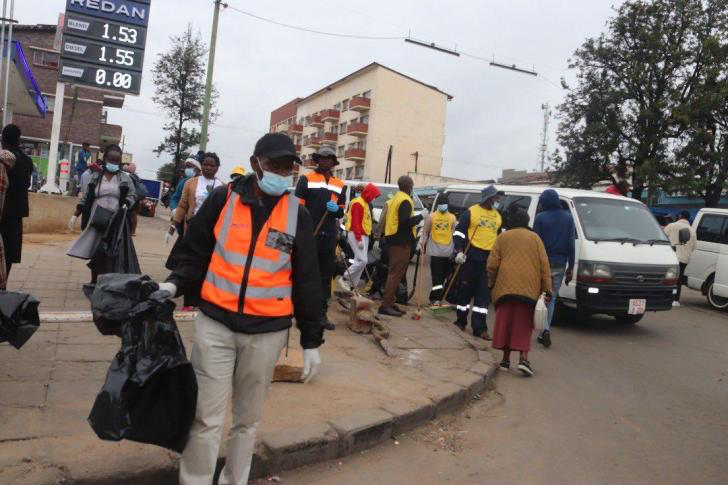
Churches in Bulawayo have joined forces with the City Council and the Office of the Minister of State for Provincial Affairs and Devolution, among other stakeholders, in a major clean-up campaign targeting a section of 6th Avenue.
The exercise was part of the National Clean-Up Day programme, which takes place on the first Friday of every month between 8AM and 10AM. In Bulawayo, the initiative is coordinated by the City of Bulawayo in collaboration with the Environmental Management Agency (EMA).
More than 50 sites across the city were cleaned during the campaign, with various faith-based organisations mobilising members to restore cleanliness and civic pride in the central business district.
Bulawayo Mayor Senator David Coltart commended the churches for their leadership in promoting environmental stewardship, saying their active participation was inspiring positive change within the community.
“The churches are setting a strong example for others to follow. Their involvement shows that maintaining a clean city is everyone’s responsibility,” said Mayor Coltart.
Representing the Minister of State for Provincial Affairs and Devolution, Honourable Judith Ncube, the Director of Coordination in her office, Mrs Boetsoarelo Noko, applauded the initiative, noting that such efforts would help Bulawayo reclaim its historic reputation as Zimbabwe’s cleanest city.
“Through clean-ups like these, Bulawayo can reclaim its former glory of being the smartest city,” said Mrs Noko.
Residents were also urged to adopt consistent waste management habits and work collectively to preserve the city’s cleanliness beyond the monthly campaigns.
BULAWAYO – A new council report has revealed that Bulawayo’s persistent water shortages are forcing businesses and residents to relocate, raising alarm over the city’s economic future and infrastructure neglect.
The report from the Future Water Supplies and Water Action Committee highlights growing concern among city councillors, who say the crisis is undermining investment and development. Councillor Tamani Moyo warned that the water shortage has led to business closures and population migration, urging the government to urgently allocate US$900,000 to upgrade the city’s water infrastructure.
Residents in areas such as Makokoba have reportedly gone more than five days without water, while other suburbs have endured dry taps for weeks. Councillor Aleck Ndlovu noted that Bulawayo’s expansion through new residential stands has increased demand, yet the city remains neglected in terms of bulk water provision.
“The city has normalised the abnormality of going a week without water,” Ndlovu said, calling for prioritisation of the Gwayi-Shangani Dam project.
Councillor Donaldson Mabuto echoed the call for government intervention, urging Treasury to fund water delivery systems and proposing that the council engage the Head of State directly to resolve the crisis.
Councillor Felix Madzana added that the issue is not a lack of water in dams, but pumping challenges caused by electricity shortages. He recommended government support for powering pumping stations.
Mayor David Coltart described Bulawayo as the only city in Zimbabwe facing raw water inadequacy. He outlined short-term goals including upgrades to the Ncema Pump Station and pipelines connecting Ncema, Tuli, Insiza, Mtshabezi, and Mzingwane. He also cited delays in implementing a solar energy contract for Mtshabezi and proposed the construction of Glassblock Dam as a medium-term solution.
Coltart acknowledged that while building the Gwayi-Shangani Dam may be feasible, laying the 450km pipeline to Bulawayo remains a major challenge.
Committee Chairperson Councillor Khalazani Ndlovu pleaded for funding to repair aging water pipes, which he said would help reduce shortages.
The council ultimately resolved to adopt the committee’s recommendations, signaling a renewed push for multi-stakeholder engagement and national support to address Bulawayo’s deepening water crisis.
By Nokuxola Mbangeni | Nov. 4, 2025 | Southern Eye
Bulawayo City Council (BCC) leaders and residents gathered in the city last week to commemorate Breast Cancer Awareness Month and World Mental Health Day 2025, amid calls for citizens to be conscious of the deadly disease’s existence and take precautionary measures.
The event, held to promote health education, early detection, and emotional support for those affected, brought together community members, healthcare professionals and civic leaders who emphasised the importance of holistic well-being, addressing both the body and the mind.
Bulawayo mayor David Coltart underscored the connection between physical and mental health, noting that the two could not be separated when addressing the challenges faced by breast cancer patients.
He said while breast cancer awareness campaigns have grown stronger, mental health often remained in the shadows.
“It is a privilege to stand before you today as we observe Breast Cancer Awareness Month and recognise World Mental Health Day,” he said.
“These two causes, though often spoken of separately, are deeply intertwined; we must acknowledge that connection in a more meaningful way, especially in our communities.”
31 October 2025 | Peter Fabricius | Daily Maverick
The ruling party’s decision to extend President Emmerson Mnangagwa’s second term in office is inflaming tensions in Zimbabwe.
Zimbabwean President Emmerson Mnangagwa’s bid for an unconstitutional third term turned violent this week.
A hall in Harare was torched hours before his opponents were to meet there to launch a campaign against his efforts to run again. And in the country’s second-largest city, Bulawayo, riot police forcefully prevented a similar meeting from taking place.
Opposition politicians intended to plan how to stop the ruling Zimbabwe African National Union-Patriotic Front (Zanu-PF) from implementing a critical resolution it adopted at its annual conference in Mutare earlier this month.
The resolution noted that at its previous conference on 26 October 2024 in Bulawayo, the party resolved that: ‘In recognition of the extensive developmental milestones and the significant socioeconomic progress achieved under […] Mnangagwa […] his term of office as President of the Republic of Zimbabwe [should] be extended beyond 2028 to 2030.’
The absurdity of the claim that Zimbabwe needed Mnangagwa to remain in power to continue his putative development agenda was illustrated by Ringisai Chikohomero in a recent Institute for Security Studies report. It showed an economy in persistent crisis, including an extreme poverty rate of more than 42%.
Zanu-PF’s 2025 conference resolution added that no notable steps had been taken to implement the Bulawayo resolution. And so the party’s secretary of legal affairs, the Minister of Justice, was directed to ensure that before the next annual conference in 2026, the resolution was “fully implemented”. The party and government were directed to initiate the required legislative amendments to “give full effect”to the resolution.
Zimbabwe’s 2013 constitution is clear that a president may serve only two terms. Mnangagwa came to power in 2017 after a military coup that toppled the country’s founding president, Robert Mugabe. Mnangagwa was elected for a first term in 2018 and re-elected for a second term in 2023. That term ends in 2028, but now the ruling party has decided to extend it to 2030.
Mnangagwa’s move has been divisive not only in the country, but also inside Zanu-PF. Zimbabwe’s vice-president, Constantino Chiwenga, is apparently bitterly opposed to the extension, because he would likely succeed Mnangagwa if he stepped down in 2028. He strongly criticised the so-called ED2030 plan at a September meeting of Zanu-PF’s Politburo.
Bulawayo mayor David Coltart, a member of the main opposition Citizens Coalition for Change (CCC), told ISS Today: “There is layer upon layer of constitutional safeguards to protect” term limits. And he should know, because he is a lawyer who helped write the constitution.
He says the constitution is clear that the president may serve just two terms of five years each. The safeguards are, first, that any amendment to the constitution requires a two-thirds majority in Parliament. Second, the decision must be confirmed with a public referendum. Third, no such amendment may benefit an incumbent. If it were, then fourth, that decision would have to be confirmed with a second referendum.
Coltart added that section 328, sub-section 7 of the constitution was worded in such a way that if the effect of any constitutional amendment were to extend a term limit, “then you need a referendum. It doesn’t matter how you couch it, what language you use, if the effect of that is to extend a term limit, it needs a referendum.”
Coltart was referring to suggestions from some in Zanu-PF that they might postpone the 2028 elections until 2030, which would implicitly extend Mnangagwa’s term. But clearly he and the other constitutional drafters anticipated that possible ruse.
The trouble for Mnangagwa is that even one, let alone two, referenda on extending his term would be disastrous for him, Coltart said, as opposition ran deep in the country and even in Zanu-PF. Any referendum would effectively be a referendum on Mnangagwa’s rule, which he would not want right now.
Coltart noted there had been only two constitutional referenda in the past 25 years. One in 2000 proposed a new constitution, which would have increased presidential powers and allowed expropriation without compensation. It became a referendum on Mugabe’s rule, which he lost. The other was the 2013 referendum on the current constitution, which 95% of the population supported. Neither outcome was favourable to Mnangagwa.
Coltart saw the attacks by Zanu-PF thugs on two premises this week as “a shot across the bows” of any attempt to rally opposition against extending Mnangagwa’s term. Early on Tuesday, the Sapes Trust’s premises in Harare were firebombed, gutting the conference room where the activists were to meet. In Bulawayo, police barricaded the Bulawayo Club where an equivalent meeting was planned.
He also said that with the opposition in disarray – partly because Zanu-PF had infiltrated and undermined it – the plans to amend the constitution had become a rallying cry for Mnangagwa’s opponents, inside and outside Zanu-PF.
The fight now seems to be on. Mnangagwa is doing his best to ensure the resolution to extend his tenure is implemented. Coltart says this includes giving new cars to all 300 members of the Zanu-PF central committee before the conference, as well as top-notch Toyota Land Cruisers to all provincial heads. Mnangagwa is also believed to have removed Chiwenga loyalists from key positions.
All this looks like preparations for a mighty battle between the party’s top two. None of it bodes well for stability or prosperity in an already poor and unstable country.
Zimbabwe Council of Churches general secretary Kenneth Mtata warned that Mnangagwa’s bid to extend his term would undermine all his efforts to re-engage the world and bring Zimbabwe in from the cold. It would also jeopardise negotiations to restructure Zimbabwe’s international debt, which had been led by the African Development Bank. And it would discourage international investment.
Perhaps so, but that is by no means clear as an increasingly transactional world has lost much of its interest in Zimbabwe as a moral issue. DM
Peter Fabricius is a consultant at the Institute for Security Studies (ISS) Pretoria.
28 October 2025 | Luci Mumbi | The Eastleigh Voice (Kenya)
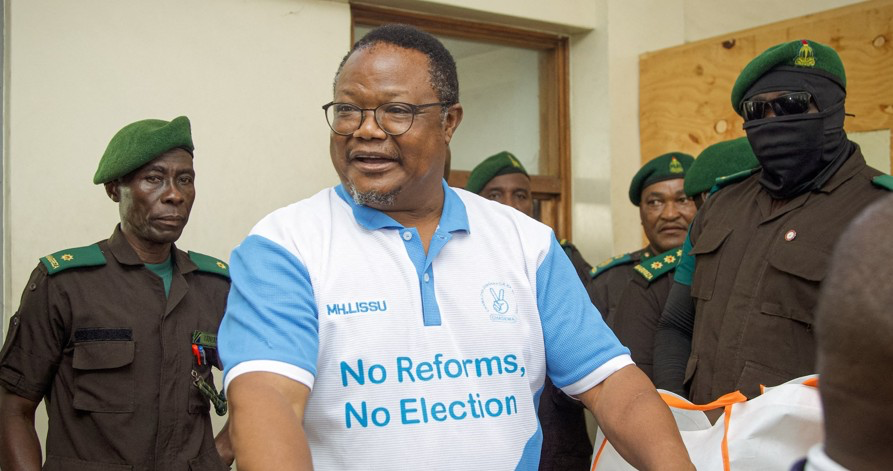
Tanzania’s opposition leader Tundu Lissu during a recent court appearance. His continued detention has drawn widespread condemnation from African leaders. (Photo: Handout)
More than 40 African and international leaders, activists, and defenders of democracy have demanded the immediate release of Tanzania’s opposition leaders, Tundu Lissu and John Heche, expressing deep concern over their detention and disappearance.
Under the Platform for African Democrats (PAD), the group accused the Tanzanian government of persecuting the two opposition figures for their pro-democracy stance and silencing dissent ahead of the country’s controversial general election scheduled for Wednesday, October 29.
In a statement dated October 28, 2025, PAD expressed “grave alarm at the recent disappearance of John Heche, Deputy Chairman of CHADEMA and the continued imprisonment of Tundu Lissu, the party’s Chairman.”
“We call for their immediate and unconditional release,” the leaders, including Nairobi Senator Edwin Sifuna, said.
According to PAD, Heche was arrested on October 22, and his whereabouts remain unknown, with authorities yet to disclose the reasons for his detention.
“The Platform for African Democrats raises its alarm that this disappearance of Heche by Tanzanian authorities indicates he is being ill-treated and not afforded his right to due process,” the statement read in part.
Call for respect and dignity
“We call on authorities to demonstrate publicly that Heche is being treated humanely, with respect and dignity. We further call on authorities to present whatever charges they may have against Heche in accordance with Tanzanian and international law and to allow access to him by his family and legal counsel.”
The leaders warned that failure to comply would confirm suspicions of enforced disappearance and urged the government to release him unconditionally.
They also condemned the continued imprisonment of Lissu, who has been in custody since April 10 after being charged with treason and publishing false information—charges PAD described as politically motivated.
“These accusations not only threaten his life under the death penalty provision but also represent a dangerous weaponisation of the law to silence legitimate dissent,” the group said.
PAD called on Tanzanian authorities to safeguard Lissu’s well-being in line with the country’s Constitution and international standards, including the UN Body of Principles for the Protection of All Persons under Any Form of Detention and the Nelson Mandela Rules.
It further urged the High Court to ensure that “the rule of law and justice prevail in his ongoing treason trial.”
“The spurious evidence being presented by state prosecutors does not withstand judicial scrutiny. If not objectively considered and decided, this trial will make a mockery of Tanzanian rule of law before the eyes of the world,” PAD warned.
State’s pretence
As Tanzania heads to its disputed polls, PAD said the government’s actions against opposition leaders expose “the state’s pretence of being a democratic, open society.”
“The lengths to which the state has gone to silence voices of peaceful dissent and opposition to the ruling regime belies its pretence of being a democratic, open society,” they said.
PAD also condemned the abduction of former Tanzanian ambassador Humphrey Polepole, whose whereabouts have been unknown since his violent disappearance on October 6.
“We are alarmed by the ongoing abductions and disappearances of other voices speaking out against the corrupt and abusive practices of the state,” the group said.
The coalition urged President Samia Suluhu Hassan to uphold freedom of expression during the election period and to release all those detained unlawfully.
“Justice for Tundu Lissu and John Heche is justice for all who believe in democracy. Let us not be silent when voices for freedom are silenced,” the statement read.
Other signatories to the declaration include former Botswana President Ian Khama, Zimbabwe’s David Coltart, Uganda’s Robert Kyagulanyi (Bobi Wine), Angola’s Adalberto Costa Júnior, Nigeria’s Peter Obi, and several other global democracy defenders.
‘Coronation’, not an election
Meanwhile, a coalition of East African civil society organisations under the #JumuiyaNiYetu movement has accused the Tanzanian government of orchestrating a “coronation” rather than an election, citing systematic repression and state violence.
In a separate statement titled “Tanzania doesn’t have an election but a crackdown disguised as democracy,” the CSOs—including the Kenya Human Rights Commission (KHRC), Vocal Africa, and the Pan African Progressive Leaders Network—said the regime had increased police presence “in preparation for a war against its citizens rather than an election.”
“The so-called election in Tanzania is a sham. The outcome was fixed the moment Suluhu strangled all opposition, silenced the media, and shut down political space,” the statement read.
The organisations claimed that over 250 people had disappeared since the crackdown began, most of them opposition members or activists. They further alleged that journalists, religious leaders, and government critics had been abducted or assaulted, with church leaders such as Bishop Josephat Gwajima and Bishop Benson Bagonza reportedly targeted.
“We stand here to state that injustice anywhere is a threat to justice everywhere,” the CSOs said.
They added that international observers from countries including Belgium, Germany, and Sweden had withdrawn from the polls, citing a lack of credibility.
“Most credible international observers have pulled out because, what, exactly, is there to observe in a coronation?” they posed.
The organisations also accused the African Union and the East African Community of turning a blind eye to the crisis, stating that “Africans are rightfully outraged that the African Union has chosen silence over principle.”
BULAWAYO City Council (BCC) requires about US$14,5 million to tackle infrastructure-related problems which include water and sewer systems, among other issues, Mayor David Coltart has said.
He made the remarks during the Matabeleland Water Indaba, a key platform in the city’s quest to find solutions to the water challenges affecting the region.
“The City of Bulawayo has, for many years, faced persistent water shortages. It is our reality that without a tropical cyclone, it is almost impossible for the city’s supply dams to fill up,” Coltart said.
“As such, the city continues to pray for good rains that will replenish our dams in the 2026/2027 rainy season. The last time the city’s dams filled up was almost a decade ago, in 2017, when the country was hit by a cyclone.”
Coltart said while they continue to hope for improved inflows, the city also requires significant investment to overhaul its ageing water infrastructure and improve bulk water delivery.
He said much of its infrastructure has outlived its lifespan, resulting in frequent pipe bursts that cause the loss of the very water they are striving to preserve.
“Council has developed short, medium and long-term strategies to address these challenges. In the short term, the city requires approximately US$14,5 million to tackle infrastructure-related problems,” Coltart said.
“This includes renewing water mains across the city, rehabilitating water pumps, replacing over 1 000 non-functional meters and repairing existing infrastructure — all aimed at reducing non-revenue water, which currently stands at 46%.”
Coltart added that the city’s medium-term measures include the private sector-led construction of the Glass Block Bopoma Dam, while the long-term and most anticipated solution to Bulawayo’s water crisis remains the construction of the Gwayi-Shangani Dam by the central government.
“The common thread among these initiatives is the need for substantial funding. This presents both a challenge and an opportunity as we rethink sustainable water strategies that will benefit Bulawayo,” he said.
“As we reflect on sustainable water strategies for Bulawayo, it is also important to examine the government’s directive encouraging local authorities to partner with the private sector in water provision — a model already in place in the City of Harare.”
He, however, said the city has proposed establishing a council-owned water and sanitation utility.
Coltart said while it may be premature to share more details, the proposal seeks to unlock financial resources for infrastructure renewal, as the municipality is often viewed as a financial risk and struggles to attract the necessary funding for water and sanitation improvements.
“In rethinking sustainable water strategies, we must also consider water recycling. With the city increasingly affected by climate change, feasibility studies are underway to assess the potential use of recycled water for industrial purposes,” he said.
“Drawing inspiration from cities such as Windhoek, Namibia, which have successfully used recycled water for years, and with advancements in technology, perhaps the time has come for Bulawayo to embrace the use of recycled water.”
Coltart said Bulawayo is not acting alone in its efforts to improve water delivery, adding that he was excited that the water indaba brought together central government, civil society organisations, researchers and academics to engage in meaningful discussions on improving water supply in Bulawayo.
“Through such collaborative efforts, we can ensure that the next generation does not face the same water challenges we have endured,” he said.
21 October 2025 | Farai Mutsaka (The Associated Press | The Seattle Times
HARARE, Zimbabwe (AP) — For over 30 years, Edith Nyachuru has carried the weight of her brother’s unexplained death.
At 16, Guide Nyachuru’s life was cut short at a Christian camp in Zimbabwe in 1992. Guide was one of over 100 boys and young men abused by British barrister and lay preacher John Smyth at camps spanning Britain, Zimbabwe and South Africa in what became one of the Church of England’s darkest scandals.
It led to the resignation of Justin Welby as Archbishop of Canterbury last year.
Now, as the church prepares to install its first female Archbishop of Canterbury and some Zimbabwean victims pursue legal action in the U.K., the Nyachuru family hopes the church and justice system will finally bring answers.
“The struggle for justice is real,” said Edith. “The most painful thing is we as a family don’t know how he died, what kind of pain he endured.”
Her 87-year-old mother, Rachel, and six Zimbabwean men who allege physical, sexual, psychological and spiritual abuse by Smyth, initiated a legal claim this month.
The claim accuses the Church of England of negligence for its inaction when abuse was first uncovered decades ago. Their attorneys, U.K law firm Leigh Day, cite the St. Andrew the Great parish in Cambridge, where a vicar’s 1982 report found evidence of abuses by Smyth at Christian camps. They are demanding a “full apology,” access to church documents, compensation and an independent review.
A trail of abuse
Smyth ran Christian holiday camps for elite British schoolboys to groom them for leadership roles in church and society. He relocated to Zimbabwe in 1984, establishing similar camps there.
The 1982 report, compiled by then parish Vicar Mark Ruston in Cambridge, detailed beatings lasting “many years.” One victim could “feel the blood spattering on my legs.” Ruston described “bruised and scored buttocks” months after a beating, noting “suppressed masochistic sexual activity” and forced nakedness “to increase humility.”
Although Ruston’s report admitted the acts were criminal, police were not informed, a decision lawyers say enabled further abuse in Africa.
In Zimbabwe, alarmed parents approached lawyer David Coltart, who compiled a damning report in 1993.
Coltart described beatings, boys forbidden underwear, forced into nude night swims, Smyth leading a prayer naked and Smyth admitting to photographing naked boys “from shoulders up” for “publicity purposes.”
Chosen to become his school’s next head boy, Guide’s naked body was found in a swimming pool at one such camp. Smyth, who presided over the funeral, was later charged with culpable homicide in Zimbabwe, but moved to neighboring South Africa, where he died in 2018 aged 75.
Guide’s family says the death could have been avoided had the church acted earlier.
“The Church of England is responsible for this. If Smyth couldn’t work with children in the U.K., why would he work with children in Zimbabwe and South Africa?” said Edith from Bedford in southern England.
Church reckoning
An independent review commissioned by the Church of England last year accused the church of a coverup, saying Smyth was “out of sight and out of mind, a problem solved and exported to Africa.”
Welby, who was a camp dormitory officer in the 1970s and knew Smyth, said he was unaware of the abuses until 2013, soon after he became spiritual leader of the Anglican church.
He later wrote a personal letter of apology to Edith. Welby stepped down in November 2024, after the review found that he failed to tell police about Smyth’s abuse as soon as he became aware of it.
The Nyachuru family now places its hope in new Archbishop Sarah Mullally, who starts official duties in January, and has vowed to rebuild trust.
“I say being a woman and a mother, you know what we are going through,” Edith said. “Can you please look into this case that has been there for decades with urgency? We need closure.”
Mullally, a former nurse, has pledged to ensure “we are a church that not only prevents abuse but responds well when it is reported.”
Attorney Rebekah Read accused the church of missing “multiple opportunities” to stop Smyth. “Instead, it chose to protect its reputation,” she said. Her clients, she said, hope the church’s leadership transition “will signal a renewed commitment to transparency, accountability and justice for survivors.”
For the Nyachurus, whose only surviving reminder of a boy who dreamed of becoming an aircraft engineer is an old photograph in the family living room in Zimbabwe, remembrance has become a quiet ritual.
“We just use candles on his date of death,” Edith said. “We go to his grave, lay flowers, sweep the area. On his birthday, we do a low-key family get-together to keep his memory alive.”
City of Bulawayo Mayor, Councillor David Coltart, has said the city is “terribly under-marketed” across key economic sectors, saying efforts are underway to attract more airlines and improve connectivity.
Speaking on Thursday evening, Councillor Coltart said he has been engaging several regional carriers to open new routes linking Bulawayo with major destinations.
“Bulawayo [is] terribly under-marketed. One of my tasks in the past year has been to persuade Fastjet to link our city to Victoria Falls,” he said.
He added that ongoing discussions with other airlines could soon yield direct regional connections.
“Recently, I have been in discussions with Safair to see whether we can persuade them to come to the city. I am just starting negotiations with Airlink to see if we can establish direct links to Durban and Cape Town,” he revealed.
Councillor Coltart said improved air access is critical to positioning Bulawayo as a competitive business and tourism hub, adding that increased visibility and connectivity would help unlock the city’s full economic potential.
Letter alleges that senior clergy and church officers ‘orchestrated a cover-up that enabled Smyth to continue abusing boys for decades’
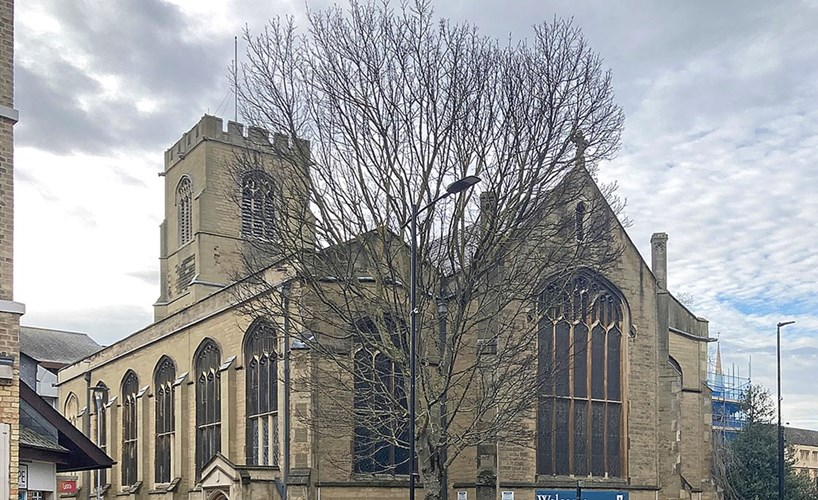
A LETTER of legal claim has been sent to St Andrew the Great, Cambridge (formerly the Round Church), on behalf of seven Zimbabwean victims of John Smyth. It alleges that senior clergy and church officers “orchestrated a cover-up that enabled Smyth to continue abusing boys for decades”.
The letter, sent by Leigh Day Solicitors, argues that the failure to report Smyth’s abuse in the UK between 1982 and 1984 “directly led to his relocation to Zimbabwe, where he continued to prey on vulnerable boys”.
The claimants are six men who say that they were abused as teenagers at Christian holiday camps run by Smyth in Zimbabwe, and the mother of Guide Nyachuru, a 16-year-old boy whose body was found in a swimming pool at one of Smyth’s camps in 1992. The abuse included forced nudity, beatings with table tennis and jokari bats, indecent exposure, groping, and intrusive conversations about masturbation.
Smyth, described in a review by Keith Makin last year as “arguably, the most prolific serial abuser to be associated with the Church of England” (News, 8 November 2024), moved to Zimbabwe in August 1984 and began to run holiday camps in the country. The move followed the completion in 1982 of a report by the Revd Mark Ruston, then Vicar of the Round Church, commissioned after a British Smyth victim grew so fearful of beatings that he tried to take his own life.
The Ruston report described beatings of “horrific” severity: two boys had received 8000 strokes over three years.
Six clerics were among those who received a copy of this report. The Makin review concluded that these individuals had carried out an “active cover-up to prevent that report and its findings — including that crimes had been committed — coming to light”.
“By the time any attempts were made to warn those in Africa, John Smyth had already begun to abuse boys and young men. . . John Smyth was out of sight and out of mind, a problem solved and exported to Africa,” the review said.
Although attempts were made by these clergy to raise the alarm in Zimbabwe, these were “weak and wholly ineffective”. Smyth “was able to abuse boys and young men in Zimbabwe (and possibly South Africa) because of inaction of clergy within the Church of England”.
The Zimbabwean claimants are seeking a full apology and a full independent review of learning from the abuses perpetrated by Smyth in Zimbabwe and South Africa, as well as financial compensation.
The Makin review makes it clear that clergy in the UK who had worked with Smyth were aware of the risk that he presented, but that attempts to warn others in Zimbabwe failed, while Smyth refused to adhere to instructions to change his behaviour. The South African evangelist Michael Cassidy, leader of African Enterprise, for which Smyth initially worked in Zimbabwe, was warned by two clerics in 1984, but told them that the move was “too far advanced to be reversed”.
In 1986, Smyth set up Zambesi Ministries to run his own camps, with no monitoring or oversight from those with the knowledge of the risk that he posed. It was a move that alarmed the UK clergy and Mr Cassidy, who agreed to send Smyth a “note of caution”. In 1987, the Rector of St Aldate’s, Oxford, Canon David MacInnes, warned Martin Kingston, a barrister who chaired the Zambesi Trust, which had been established to raise funds to support the Smyth family.
In 1989, Smyth’s abuse was exposed in an autobiography by John Thorn, a former Winchester School headmaster, prompting the Zambesi trustees to resign en masse. The Revd Mark Ashton declined Smyth’s invitation then to take up the chair, saying that he “personally” believed that Smyth should not be working with young people, and that he should “come under the pastoral responsibility of a Christian leader who is fully aware of the past”. The new board should meet with him, or other clergy aware of this past, he suggested.
Smyth’s work was “vulnerable to errors of judgement or other attacks by the devil”. He added: “You have never been an easy person to advise against your will!”
Instead, Jamie Colman (now Sir Jamie), a young lawyer who had attended Smyth’s camps in the UK, took up the chair of Zambesi Trust UK. In response to Mr Ashton’s concerns, Mr Colman suggested that the situation was “different” because Smyth was in a “pastoral arrangement” with clergy in oversight, and “once fallen in a particular fashion, are you thereafter disqualified until the very end of the game?”
Mr Ashton also wrote to Smyth, urging him to stop working with young people.
In May 1993, several parents of boys who had attended Smyth’s camps in Zimbabwe complained to Baptist and Presbyterian ministers in Bulawayo “regarding severe beatings received by the boys on camps, compulsory skinny dipping, nude trampolining and allegations of Mr Smyth walking around in the nude at bedtime and at shower time in front of the boys”.
The ministers — aware of allegations raised by other church leaders — felt that complaints made to the Zambesi Ministries board and to Smyth had been ignored, and so approached David Coltart, a prominent human-rights lawyer.
When Jamie Colman met with the pastors in July 1993, he argued that that there was “nothing improper” about Smyth’s conduct, that the Zimbabweans had a different attitude to beating, and that, in line with Matthew 18, lawyers should not be involved.
Richard Johnson, chair of the Zambesi Trust in Zimbabwe, contended that Smyth was “a strong, forceful Christian with deep commitment to converting and disciplining young men” and that “his failure in Britain should not be allowed to negate the many successful years of youth work before and since the Winchester incidents.”
Smyth’s lawyer warned the pastors that they might face an action for defamation. The board accused them of a personal vendetta.
After the death of Guide Nyachuru in December 1992, Smyth was charged with culpable homicide in September 1995 and, later, in April 1997, with five counts of criminal injury, when five boys were harmed. The prosecution was discontinued when it was successfully argued by Smyth’s legal team (largely led by Smyth himself) that the prosecutor had a conflict of interest.
The camps continued. Smyth justified the nudity and beatings in letters to parents, presenting himself as a “father figure”, suggesting that the nudity was “part of the all-boys-together fun of the camp”, and that beatings were necessary to “deter high-spirited naughtiness”. The Coltart report recorded that at least two boys had table-tennis bats broken on their backsides. One boy was found with a 12-inch bruise.
One of the claimants, Rocky Leanders, said last week: “The memory of the shame and humiliation I suffered to satisfy John Smyth has never left me. After the Makin report was published I expected some redress. But none came. I feel increasingly angry that the Church of England exported this criminal to Zimbabwe.”
A Church House spokesperson said: “We are truly sorry for the horrendous abuse carried out by John Smyth and the lifelong effects on survivors, both here and in Africa. The Church in South Africa has already carried out its own review. We have been in contact with the Church in Zimbabwe and offered to support and contribute financially to any review that it might choose to undertake, building on the review undertaken by David Coltart in 1993. The Church of England is working through the recommendations in its own learning lessons review. The National Safeguarding Team has taken out complaints under the Clergy Discipline Measure against a number of clergy criticised in the review. That process is ongoing.”
In a statement, a spokesperson for St Andrew the Great, Cambridge, said: “We are full of sorrow about the horrendous abuse carried out by John Smyth which has had lifelong effects on survivors, both here and in Africa, and that he was not stopped sooner.
“While we are unable to comment on the specifics of this claim, we take the safety and wellbeing of our congregation, staff and volunteers extremely seriously and follow Church of England’s Safeguarding Policy and Practice Guidance designed to protect vulnerable people.”