Military takes over Zim hospitals as doctors strike over ‘abduction’

TimesLive

BY LENIN NDEBELE

17th September 2019

In a bid to contain a crippling doctors’ strike in Zimbabwe, the country’s government has deployed doctors from the military to state hospitals.

Doctors went on strike on Tuesday after one of their own, union leader Peter Magombeyi, was allegedly abducted by state security agents.

Despite calls for information on his whereabouts and doctors’ declaration that they would not return to work until he is found, no headway has been made.

During a press briefing on Tuesday evening, health minister Obadiah Moyo said military doctors would provide services at public facilities as a “temporary measure”.

At the same briefing, information minister Kazembe Kazembe said there were no signs that Magombeyi had been abducted and this case would therefore be treated as a “disappearance”.

Dr. Peter Magombeyi, who was allegedly abducted.

Dr. Peter Magombeyi, who was allegedly abducted.
Image: Twitter via @ZctuZimbabwe

State security minister Owen Ncube said that despite telling his officers to approach the case with “an open mind”, they should check if a “third force” is involved.

“I have instructed security forces to investigate whether or not a third force is involved,” he said.

A “third force” in corridors of Zimbabwean politics refers to elements suspected to be linked to the late former president Robert Mugabe and who intend to destabilise the regime of President Emmerson Mnangagwa.

Abductions are not new in Zimbabwe’s violent socio-political history. Some of the most notable kidnappings include the following:

  • Nationalist Edson Sithole and his secretary Miriam Mhlanga, who were taken into a car in October 15 1975 and never seen again;
  • Edwin Nleya, a captain in the army, who disappeared without a trace in 1989 from the infantry battalion in Hwange after threatening to expose army bosses involved in poaching and ivory trade. His decomposing body was found two months later; 
  • Rashiwe Guzha, a secretary at the Central Intelligence Organisation (CIO), who went missing in May 1990. She was declared dead but her remains were never found;
  • Patrick Nabanyama, then a polling agent for David Coltart in the June 2000 parliamentary election, who was abducted on June 19 2000. He was never found and on August 11 2010 he was legally declared dead;
  • Former journalist Jestina Mukoko, then a human rights activist and director of the Zimbabwe Peace Project, who was abducted on December 3 2008 for allegedly being involved in planing anti-government demonstrations that day; and
  • Journalist turned activist Itai Dzamara, who was kidnapped on March 9 2015. He is yet to be found or declared dead.
Posted in Blog | Leave a comment

Mangwana blames doctor’s abduction on ED attempted assassins

NewZimbabwe.com

16th September 2019

By Leopold Munhende

INFORMATION Secretary Nick Mangwana has blamed Saturday’s abduction on doctors union leader Peter Magombeyi on what he termed third forces which he linked to President Emmerson Mnangagwa’s shock escape from a Bulawayo bomb blast last year.

Mugombeyi was seized by suspected State agents from his Harare home in Budiriro after the Zimbabwe Hospital Doctors Association (ZHDA) in which he is acting president had embarked on a crippling strike action to press for improved wages.

The move, widely condemned as an act of intimidation on workers by Mnangagwa’s government, follows recent similar abductions on several government critics.

However, Mangwana blamed the so-called third force for the kidnap incident.

“There is definitely a third force trying to stir things a certain way, the same force that tried to eliminate the President on 23 June 2018,” Mangwana said Monday on Twitter.

“This Administration has no reason to destabilise this country by abducting its citizens, threats to the security of persons and acts of terror are ultimately threats to the security of the State.

“There is no rhyme nor reason for the State to undermine itself #3rdForce.”

Mnangagwa survived the bombing incident that claimed two Presidential security aides and left more, including the two State Vice Presidents, injured.

Responding to Mangwana on Twitter, MDC top politician and former Education Minister David Coltart dismissed the assertions, pointing to Foreign Affairs Minister Sibusiso Moyo’s alleged violent crackdown on voters in 2008 whilst still in the army.

“The objective history of post-independence Zimbabwe shows that Zanu PF has always denied being responsible for abductions and disappearances but that they are usually shown to be at the centre of these crimes. What has changed?

“Some of the top leaders of the Mnangagwa regime have been accused of similar crimes in the past, for example, human rights reports from 2008 implicate the Foreign Affairs Minister in abductions of MDC activists which occurred in his then zone of command Midlands,” said Coltart.

Posted in Blog | Leave a comment

The other side of Mugabe

The Standard

15th September 2019

BY NQABA MATSHAZI

In the late 1990s, a big birthday bash was planned for the late vice-president Joshua Nkomo at Ascot racecourse, with the late former president Robert Mugabe being the guest of honour.

When Mugabe arrived, with a huge convoy as usual, other guests were told to clear the way, but one man, rugged and probably slightly intoxicated, remained defiant and muttered under his
breath: “Mugabe, Mugabe chi ichocho?” (Who is Mugabe?)

Lo and behold, Mugabe’s security heard him and not before long they had pounced on him ready to mete instant justice.

Nkomo quickly intervened, whispered to Mugabe, asking if he had forgotten who the obstinate man was. The man was a former detainee, who was detained together with Nkomo and Mugabe.

Mugabe then called the man closer, dug into his jacket pocket and gave him some money.

The following day, The Chronicle carried a picture of that man, sleeping on the ground at Ascot, dead drunk, courtesy of Mugabe.

Another story is told of a man who worked at State House in Bulawayo.

His brother joined the MDC and was soon one of their candidates in a by-election.

Soon the hawks were on the State House employee demanding that he be summarily fired; since his brother was an MDC candidate it meant that he also belonged to that party and should be
axed immediately for being a sellout.

The guy was quickly ostracised and he waited for the guillotine.

The issue came to Mugabe’s attention on one of his visits to Bulawayo.

Mugabe summoned the man, who must have feared the worst.

Mugabe asked him one question: “Do you still want to work here?”

Timid and scared, words failed the man and all he could manage was a weak nod.

Mugabe then looked to State House officials and told them that if the man wanted to work, he could continue working; that his brother was an MDC official was not an issue.

In another case, Mugabe spotted a soldier wandering around State House grounds and summoned him.

He asked the soldier what he was doing and the soldier said he was on leave.

Oh dear, if he was on leave, shouldn’t he be with his family, Mugabe demanded to know.

The soldier removed his payslip, showed it to Mugabe and told him that he could not afford to go to his rural home, where his family was.

That embarrassed Mugabe, who promptly gave the soldier some money and sent him off on his way.

The mandarins at State House were not too pleased at this and, if I am not mistaken, immediately began proceedings to discipline the soldier.

Those who knew and were close to him, say Mugabe was disarmingly charming.

They say he was quite warm and affectionate.

He ensured that he knew all his close employees and followed up on their lives.

When former Education minister David Coltart’s daughter was bitten by a lion, Mugabe took him aside at a Cabinet meeting, to ask about her well-being.

Coltart had been a thorn in Mugabe’s side for eons and the president probably had every reason to revel in the MDC politician’s ill fortune.

But on that day, Coltart wrote that Mugabe “appeared genuinely concerned about her”.

It is very difficult to reconcile this side of Mugabe with his other side, where he is accused of being a malevolent mass murderer.

He was a very complex character depending on whom he was engaging and I guess everyone has their own Mugabe story to tell, no matter how polarised the narratives are.

Posted in Blog | Leave a comment

Andy Flower hopeful for Zimbabwe’s future after Mugabe’s death

Bulawayo News 24

8th September 2019

Andy Flower, the former Zimbabwe cricket captain and England coach, hopes his country can emerge from “a quagmire of corruption” following the death of ex-president Robert Mugabe.

Mugabe died on Friday at the age of 95, two years after being ousted from power.

In 2003 Flower joined team-mate Henry Olonga in a black armband protest at a World Cup match in Harare — decrying the death of democracy in Zimbabwe.

The brave, and potentially dangerous, stand ended the international careers of both men and Flower moved to England, eventually going on to become a three-time Ashes winning coach of the national team.

In a statement released to the PA news agency, he responded to Mugabe’s death noting his history of opposition to the regime and his wishes for a brighter future under new leadership.

“I am very obviously reticent to praise Robert Mugabe in any way. He was not a good man. He subjugated his people and allowed a small group of his chosen elite — his partners in crime — to fleece the country,” said Flower.

“He has acted with incredible cruelty to the average Zimbabwean, completely mismanaging what could be a thriving economy.

“I shook hands with him on a number of occasions in my role as a Zimbabwean cricketer, but never conversed with him. The opportunity to do so certainly disappeared after the black armband protest with Henry Olonga in 2003 to mourn the death of democracy in Zimbabwe. We wanted to highlight the human-rights abuses occurring at the time.

“I do believe, that given the chance, the country’s young, with a zealous focus on integrity and growth could once again see Zimbabwe thrive and push towards a rightful place as a role model for other African countries.

“I hope that people such as David Coltart and Henry Olonga, role models of courage and selflessness, will inspire future leaders to guide us out of the quagmire of corruption the country has been consumed by for so long.”

Flower, who still works for the England and Wales Cricket Board, went on to question whether any such progress could be realised under the president Emmerson Mnangagwa — a long-time Mugabe ally in the Zanu-PF party.

“It can’t happen under the current rein of Mnangagwa, this is for certain, but institutional immorality cannot stay in place forever,” he continued.

“My true optimism sits in hoping that this regime ends soon, the people of Zimbabwe deserve better.”

Posted in Blog | Leave a comment

Robert Mugabe: The greatest trick the devil ever played

The Standard

By Siphosami Malunga

8th September 2019

The fallacy of the hero-turned-villain narrative of Robert Mugabe is the greatest trick this devil ever played.

The closest I have to feeling anything is quiet, seething rage.

Rage that this man who killed thousands and destroyed so many livelihoods has died without facing justice for the atrocities. I am not religious, but want now more than anything to hang tightly to the promise of purgatory — the halfway house and hell’s holding cell.

He escaped justice in this life, I pray it is waiting for him in the next. I hope he is “under arrest” right now and will be denied bail just as he arrested and denied the thousands he persecuted in his four decades in power.

Many say they are conflicted about Mugabe, whom they call a pan-Africanist, father of the Zimbabwean nation and a hero-turned-villain. I personally do not suffer from this conflict.

Credited by some for his gallant role in leading Zanu in the last very short leg of the liberation struggle from 1975 to 1979 — only four years — he gets far more credit than he deserves.

The gallantry and heroism, according to his closest comrades, is manufactured.

His recruiter into the liberation struggle and companion on the surreptitious journey to Mozambique, Edgar Tekere, former secretary-general of Zanu-PF, spoke in his book, of a reluctant, scared and unwilling participant of the struggle into which he was foisted because he, with his multiple academic degrees, spoke and wrote well compared to the other guerillas.

Much like his cousin and nationalist James Chikerema who spoke of the narcissistic and self-absorbed young bookish boy who threw tantrums and abandoned other boys when they herded cattle. Revelations that would help illuminate the man’s behaviour in later years.

He wanted everything done his way. He never tolerated dissent during the liberation struggle and after. He stoked controversy on his role in the death of Josiah Tongogara, the Zanla commander, in 1979 in order to ostensibly consolidate his control over Zanu-PF. Tongogara preferred a united front under Joshua Nkomo.

After independence having decided Zimbabwe would be a one-party state, he demanded and required full compliance and loyalty. When his comrades questioned it, they were sidelined.

He brutalised Nkomo and his party for resisting the one-party state. He coveted and desired absolute power. Always wary and spiteful of contenders to power in Zanu-PF.

He expelled erstwhile right-hand comrades like Tekere, Eddison Zvobgo, Dzikamai Mavhaire, Margaret Dongo, Enos Nkala, Solomon Mujuru, Didymus Mutasa, and Emmerson Mnangagwa. He toyed with them by bringing some of them back when he felt they had learnt their lesson.

The lesson being there is only one leader. And his name is Mugabe. He maintained a divide- and-rule system built around fear and suspicion. His comrades both feared him and mistrusted each other and could never muster a revolt against him.

Attempts to do so were sure to be fatal with many dying under suspicious circumstances — usually car accidents, alleged poisoning or other undisclosed sudden illness — methods which his comrades readily used against each other.

To ensure his comrades toed the line, he built a zero-sum, kill or be killed, do-or-die party system in which you were either in or out and once out one either fled into exile or were stripped of everything the party had allowed them to accumulate.

Gukurahundi

He was aloof and cold. Vengeful and unforgiving. In 1980, fearful of Nkomo, his party and better trained guerillas, he spent considerable resources to build his own army militia answerable to him and ready to do his political and ethnic bloodletting.

The Gukurahundi or 5th Brigade was a private army with instructions to kill, rape, torture and plunder Nkomo and his supporters into submission. He did not stop until 20 000 people were dead. He would never have stopped had Nkomo not capitulated and sworn allegiance to his authority. Only total submission and subjugation assuaged Mugabe.

There is nothing in his record that shows benevolence or democratic credentials. He never sought to build a nation, but stoked and amplified tribal differences advantaging his Zezuru clansmen and entrenching a sense of exclusion and marginalisation amongst other clans.

In the 1980s he spoke of destroying opposition Zapu and he kept his promise through Gukurahundi, killing thousands of its largely Ndebele supporters. He left a country more ethnically divided than it was when the liberation struggle began. He politicised ethnicity, conveniently labelling the multi-ethnic Zapu as a Ndebele party as a pretext to destroy it.

His demagoguery left Zimbabwe collectively carrying his individual guilt and responsibility and a real sense of exclusion and grievance. He pretended to manage inclusion by appointing “yes men” from different ethnic groups with little intention or desire at deepening inclusion.

In 1990, he warned supporters of the Zimbabwe Unity Movement (ZUM), led by his erstwhile comrade Tekere, that one way to die was to vote for ZUM. The result was an unleashing of violence which culminated in the shooting of Patrick Kombayi by officers of his Central Intelligence Organisation.
He would later give the two officers amnesty after they were convicted for attempted murder. He readily gave all his comrades amnesties whenever they transgressed — including committing serious crimes like murder and corruption, a clear indication of his disdain for rule of law.

He berated judges who made decisions he did not like and unleashed his militia to intimidate the Chief Justice in his office to force him to resign.

In the 2000s he unleashed Zanu-PF militia against MDC’s Morgan Tsvangirai, killing hundreds. Simultaneously, sensing that he was running out of cards he turned on white commercial farmers who had supported him earlier when they showed disloyalty and support for the MDC.

A mastermind — in one master stroke — he struck at both the white farmers and the MDC and claimed the ultimate prize of winning back votes by giving back the land and decimating the opposition whilst claiming the high anti-colonial moral high ground in Africa and elsewhere because no sane Zimbabweans could question the need to redress the land problem which had been the basis for the armed struggle. But he kept the best farms for himself, his cronies in Zanu-PF and the military who went on a looting spree, grabbing multiple farms for
themselves and their families.

Always a political opportunist, realising that the opposition drew its support from urban centres, in 2005, he unleashed his wrath on the urban population, destroying homes in an operation known as Operation Murambatsvina (Reject Dirt) that the UN characterised as approximating crimes against humanity.

At the end of the day, his arrogance and hard-heartedness meant that even his comrades were afraid to contradict and challenge him. It also meant that he surrounded himself with like-
minded violence mongers who readily did his bidding and personally benefited from it.

He was unforgiving and willing to falsely rewrite the nationalist struggle for independence so that only he was the pre-eminent and leading nationalist — despite having only taken charge of Zanu-PF in 1977, two years before the ceasefire.

He always placed his contribution above and beyond far worthier forebears like Nkomo, Ndabaningi Sithole, Lookout Masuku, George Silundika, Herbert Chitepo, Leopold Takawira, and Jason Ziyaphapha Moyo.

He appropriated the National Heroes Acre as a private cemetery only for people he approved, excluding Masuku, Sithole, Chinx Chingaira and others.

In the end, as his relentless pursuit for them intensified, his comrades overcame their fear and deposed him. That they had to use the army demonstrated the entrenchment and instrumentalisation of violence to retain and obtain political power.

None of the touted democratic process in Zanu-PF would work to remove him. To remove him, his comrades would need to violate their party and national constitution and depose him via a coup. This was the legacy he left, 40 years into his rule.

Compared to other liberation movements in the region which saw many successive, democratic and party-sanctioned changes of presidential power, he bestrode Zanu and Zimbabwe like a colossus expecting to concede power to the only thing that did not fear him — death.
In 2001, when coming from Johannesburg on landing at Harare International Airport, now named after him, he declared that the white people in Zimbabwe and those in MDC should go back to England or be imprisoned. He singled out Roy Bennett and David Coltart, whom he had personally telegrammed to come back in 1980.

Separately, he was unleashing violence against the new MDC and selectively distributing food aid when hundreds of thousands faced hunger in the middle of one of the worst droughts the country has faced.

I felt compelled to act against what was clearly an intensification of systematic attacks against innocent civilians and the opposition. I decided to write him a letter from East Timor — where I was working in the Tribunal that was dealing with crimes against humanity — to register my concerns and to “reprimand” him.

Expectedly, I never received a response but more importantly, the MDC white politicians were spared arrest. A few months later, to my shock, I received information that there were discussions between the MDC and one of the former Rhodesian colonels, Lionel Dyke, implicated in Gukurahundi — on giving Mugabe amnesty for the most egregious of his crimes.

I tried unsuccessfully to find any of the implicated colleagues in these secret talks — which were presumably planned for South Africa — to get the real story. None was available.

Besides witnessing and being affected by Gukurahundi directly as a child, as a law student, I had been a junior researcher and volunteer at the Bulawayo Legal Projects Centre, which had
produced the Catholic Commission for Justice and Peace, Breaking the Silence Report on the atrocities.

I had met many of the victims who streamed in to tell their stories. I was upset that there could be a discussion of amnesty without hearing the victims. I was left with only one option: To write.

I called Iden Wetherell at Zimbabwe Independent and asked whether he would publish a piece the following Friday. It was Wednesday and he said he had already completed his layout and I was too late.

I implored him that this was of national importance and could not wait until the following week. It would be too late. Iden — who many may not know is not just former Zipra cadre, but a holder of a doctorate from before one could purchase them — gave me a lifeline: “You can send it now. Just email it.”

But I had not written it. I was going to write it at night. He could not promise, but asked me to send it. I did not sleep that night and sent to Iden a piece entitled: “Amnesty for Mugabe for Gukurahundi out of the question.”

I then crossed my fingers and held my breath. On Friday, I was delighted to see that Iden had published it on his front page. He had apparently “agreed” on its national importance. In my piece, I berated anyone, including MDC leaders, for arrogantly thinking they could have a mandate to negotiate an amnesty for Mugabe for Gukurahundi without a mandate from the victims.

What followed was even more interesting. At a rally the next day, Tsvangirai distanced himself from amnesty talks and said the MDC would pursue justice. I felt vindicated for the sleepless night.

More would follow. A few weeks later, at Heroes Acre where my mother goes every year on Heroes Day (for my father), she reported that Mugabe had spoken to her at my father’s grave and asked: “MaSibanda,how are you and the children?”She had responded that we were all fine. “How is your son?” he had further asked. “But I have many sons, Mr. President” she had replied: “Ngitsho uSipho, unjani uSipho?” he interjected.

She was puzzled but replied that I was fine. “Is he still in East Timor? “Yes he is, Sir,” she replied. “Oh, okay. That’s good! Tell him we are proud of him and he must keep up the good work,” he said as he walked away.

The Zapu comrades in the presidency had then cornered my mother and said:”Please tell our son Sipho to call us. We know he may be unhappy about some things, but there is no need to write to newspapers when we are here”.

My mother called to say I should not come back home because there was something in the way Mugabe had asked after me. I laughed her concerns off and a few months later I was on a flight back home on leave.

I would continue to write critiquing him, at times using pseudonyms when I worried about exposing relatives and loved ones. I knew Mugabe’s wrath from when I was a 10-year-old boy. My father, Sidney Malunga — as Zapu spokesman who exposed his atrocities — got the worst of Mugabe’s brutality.

Starting barely a few months into independence in 1980, countless night-time raids at home and arrests, detentions incommunicado, torture, sham trials, acquittals followed by further unlawful detentions for years on end.

So we “lived” with Mugabe in our house.

He was a constant feature. My father ranting about him or his party. My older brother Busi (20) and cousin Ronald (17) arrested and detained at Brady Barracks in lieu of my father. His intelligence goons intimidated and turned our house upside down, the sweeteners he would offer my father — an ambassadorial post here or there —which he would dismiss saying that he was not for sale.

The continuous consciousness of an ever-present and ever-looming danger. That is what Mugabe represented to me from an early age. This would not change in my adulthood as I became a critic of his misrule and advocate for him to face justice for his heinous crimes. It has not changed now.

Much will be said by others about his misrule and economic destruction of the country and its people’s livelihoods that there is little point in repeating.

More about how he allowed, facilitated and encouraged corruption by his comrades, rewarding and never punishing it. He revelled in false positive acclaim that he was corruption-free, but was just surrounded by thieves.

But which honest person only surrounds himself with only corrupt people and worse still promotes them? There is no doubt in my mind that he too was corrupt.

Willowvale Motor Scandal, to War Victims Compensation corruption scandals and many others, he was clearly the head of a corrupt system not the victim of dishonest company.

This would become even more apparent when his wife looted the national housing scheme to build a private mansion which she would later sell for a huge profit, when he leveraged state resources for his farming businesses, when he forced the army and police to buy his produce, when he and his wife grabbed multiple farms.

He selectively and conveniently peddled pan-African credentials to shore up support for his disastrous economic and political policies. Whilst killing and beating his own African citizens, stealing elections, starving opposition supporters and plundering public resources, he railed against imperialist forces blaming them for all his failures because of travel and others sanctions they imposed on him personally and his lieutenants.

He left nothing to show for ruling a country for almost 40 years except decay. His touted legacy of significant investments in education manifest in a collapsed education system in which in some rural children still learn under trees, teachers earn $25 and learners can barely afford fees.

In a twist of irony, he may have invested in his political longevity as educated Zimbabweans fled the country in thousands to seek opportunities all over the world. They would remit money and food home to relatives when the economy and living conditions tanked and hyper inflation set in – effectively saving his bacon.

That he died in a Singapore hospital where he battled illness for over half a year is testament of his catastrophic and shameful failure not just to build a viable health system but to simply maintain what he inherited from the Rhodesians.

Worst of all, even though he was deposed in 2017, he bequeathed to the country a monstrous political system run by a small political, predatory and corrupt elite comprised of his cronies with greater interest in advancing personal and not public interest.

In that sense, he never left even in death.

His legacy of stolen elections and violence continues to determine the primary basis of political engagement as shown by the army shootings if August 2018, and the heavy handed security response to protests in January and August 2019.

When a person dies, the task of encapsulating and narrating their life becomes critical.

There are always multi- dimensional narratives about any person – and especially a larger than life figure like Mugabe. In African custom the saying goes that “a dead person becomes a good person” akin to “never speak I’ll of the dead.”

But facts are stubborn. Mugabe brooked no resistance from anyone – inside his own movement and outside. He readily eliminated every one of his enemies – inside and outside his movement going back to the liberation struggle.

He mastered, deployed and instrumentalised violence, demagoguery and hate for political ends. For the most part it worked well for him until it was used against him. Having drawn and tasted blood of 20,000 Ndebeles in the 1980s, he considered the death of a few MDC supporters in 2008, child’s play, boasting that, of the multiple academic degrees he held, he coveted most his degree in violence.

Mugabe never changed. He never turned from hero to villain. He was always a villain. The greatest trick this devil ever played was to persuade people that he did not exist.
But fortunately death is an equal opportunity arbiter. The only time abusers experience the same and equal treatment as their victims.

The main regret is that he died without facing justice for his atrocities which would have helped his victims find closure.

The only silver lining is this dark cloud is that some of his accomplices are still alive to account for their atrocities and for destroying the hopes, dreams and livelihoods of millions Zimbabweans.- Africa Report

Siphosami Malunga is a Zimbabwean lawyer and he writes here in his personal capacity.

Posted in Blog | Leave a comment

Zimbabwe’s ex-President Robert Mugabe Leaves a Mixed Legacy

Inter Press Service

By Busani Bafana

7th September 2019

 Former Zimbabwe strongman Robert Mugabe, who died this week, aged 95, leaves a mixed and divisive legacy.

Mugabe – the oldest African leader when he was removed from power in November 2017 – died of an undisclosed illness in a hospital in Singapore on Sept. 6.

Once a revered hero who liberated Zimbabwe from the brutal colonial rule in 1980, Mugabe ruled the country for 37 years before he was deposed in a military coup in 2017. Mugabe’s once-trusted comrade and enforcer, who later turned foe, Emerson Mnangagwa, became president in a 2018 election which was disputed by the opposition.

Describing Mugabe as the iconic leader of the struggle for national liberation, Mnangagwa paid a glowing tribute to Mugabe who sacked him as vice-president in 2017.

“A pan Africanist fighter, Comrade Mugabe bequeaths a rich an indelible legacy of tenacious adherence to principle on the collective rights of Africa and African(s) in general and in particular the rights of the people of Zimbabwe for whom he gave his all to help free,” Mnangagwa said in tribute broadcast hours after he confirmed Mugabe’s death on his official twitter account.

The fighter Mugabe was known for many things, including securing and protecting his own hold on power after he became the country’s Executive President in 1987, the same year he forged an uneasy unity accord between the country’s main political parties, the Zimbabwe African National Union Patriotic Front  (Zanu PF) and the Patriotic Front Zimbabwe African People’s Union (PF Zapu).

A political colossus

Many adjectives easily fit Mugabe; liberation fighter, diplomat, patriot, pan Africanist, Marxist, strategist, shrewd contriver and master manipulator. Mugabe was also a highly intelligent man and an accomplished scholar, attributes that endeared him to many.

“There is no doubt that Robert Mugabe will go down as a colossus in Zimbabwean history,” David Coltart, former Education Minister and human rights activist, told IPS.

“He has a remarkable impact on Zimbabwe both positively and negatively and his positive legacy is that he fought a bitter struggle with Joshua Nkomo to end white minority rule that will be an enduring legacy. The other positive legacy is he expanded a quality education to all Zimbabweans and he must be given credit for that. He built on the legacy of Garfield and Grace Todd from the 1950s and expanded education.”

Coltart concedes to Mugabe’s less than illustrious legacy, noting that Mugabe perpetuated the violence of the former minority white Rhodesian Front government by disrespecting the rule of law and constitutionalism, growing corruption, abuse of office and the destruction of the Zimbabwean economy which forced hundreds of thousands to leave this southern African nation.

“History will tell on balance whether his legacy is more positive than negative,” Coltart said. “There is no doubt he was revered within Zimbabwe and revered throughout Africa. Indeed one could argue that he was more popular in the rest of Africa than he was in Zimbabwe himself. There is no doubt he mellowed in the final few years of his life, he mellowed in the inclusive government and reached out to the [opposition] MDC [Movement for Democratic Change] and the country settled to a certain extent and the country grew.”

“As Education Minister I worked well with him and we had a good functional relationship and we managed to stabilise the education sector and get it on a growth trajectory again, but of course during that period corruption continued to flourish in the country and after 2003 he allowed corruption to continue and allowed the constitution to be breached in the many ways that it was,” he said.

From liberator to dictator

Praised as a nation builder at independence when he extended the hand of reconciliation across the racial divide, Mugabe was not only a political liberator per se. He sought to liberate his country from poverty too, promoting investment in education, social welfare, industrialisation and food security.

In 1998, Mugabe was awarded the 100,000-dollar Africa Prize for Leadership for the Sustainable End of Hunger given by the Hunger project, a New York global aid organisation in recognition of his stewardship in Zimbabwe’s agriculture success story. The country’s agricultural programmes were praised for having ”pointed the way not only for Zimbabwe but for the entire African continent in fighting against hunger”, the organisation had said at the time.

Tragically, Zimbabwe is today no longer the food security champion in part as a result of its well-meaning but poorly executed land reform programme in 2000.

But Mugabe was a gifted orator with a quick wit and memorable sound bites. The fight for land and self-rule became hallmarks of this tenure.

“We fought for our land, we have fought for our sovereignty, small as we are, we have won our independence and we are prepared to shed our blood…so Blair keep your England and let me keep my Zimbabwe. We are still exchanging blows with the British government,” Mugabe once said in a famous spat with the then British Prime Minister Tony Blair.

David Moore, researcher and political economist at the University of Johannesburg, said Mugabe manipulated the very deep factions and divisions both in Zimbabwean society and the political system to his advantage, starting from the formation of Zanu PF in 1963. Mugabe, Moore told IPS, had a knack of getting people to do his dirty work and finding allies when he was in trouble. For example, Mugabe made alliances with the war veterans in 1997 that pushed him onto the fast track land reform and triggered an economic meltdown that the country has battled to recover from.

“We cannot forget the Gukurahundi where he destroyed a political party and ended up with almost a genocide evolving from that, so l mean anybody who says he is a hero is really missing the point,” said Moore. Gukurahundi is remembered as a series of massacres on civilians and members and officials of Joshua Nkomo’s Zapu that were carried about by the Zimbabwe National Army.

Moore added that this ability to manipulate and work out and exacerbate these factions kept Mugabe in power and Zanu PF unified to a degree even though the unification was based on subterfuge, lying, deceit and playing groups against each other.

“It is a complicated and contradictory legacy how this shy, almost paranoid guy managed to stay on top of the heap and created also a culture of corruption, even though he would say, we need a leadership code,” Moore said.

The emergence of the political party MDC led by trade unionist Morgan Tsvangirai in 1999 unnerved Mugabe. Mugabe’s turned to violence in the elections in 2000, 2005 and 2008 of which the opposition claims to have won outright.

Violence in the form of beatings, torture and of late kidnappings became emblematic of Mugabe’s intolerance of dissenters. Individuals and civil society were not spared.

Human rights activist an Mugabe critic, Jenni Williams, was a victim. As the national coordinator of Women of Zimbabwe Arise (WOZA), she was arrested a number of times as the organisation continues to pursue a “non-violent struggle for socio-economic rights”.

“Unfortunately Mugabe’s leaves a legacy of repression and persecution which overshadows any good he may have done,” Williams said.

“I find it hard to mourn a man who caused me such personal persecution and suffering. Under his rule and orders I faced arbitrary arrest, inhuman and degrading treatment and constant persecution by prosecution. I am just one of many who suffered the mayhem of his rule and hatred of the people of Matabeleland leading to mass murder.”

Williams says the dictatorship system Mugabe nurtured is still in place and no real development and economic recovery can be achieved without serious reforms at all levels. Therefore poverty levels are systemically increased out of cruelty.

Burying Mugabe will close a chapter in the life of founding figure but the economic and political fortunes triggered from his rein are worsening.

It is not only food that Zimbabwe is in short supply of these days. Many other things, such as lack of health care and education, can be traced to the ill-informed policies that Mugabe enforced in securing his hold on power.

Posted in Blog | Leave a comment

A complex and brilliant man, but with a dark side: David Coltart on Mugabe

ZimLive.com

6th September 2019

Tributes are being paid to former President Robert Mugabe who died aged 95 on Friday.

Mugabe, who ruled Zimbabwe for 37 years before he was overthrown by the military in 2017, died in a hospital in Singapore after being admitted in April this year.

Movement for Democratic Change treasurer David Coltart served as Mugabe’s education minister during a power sharing government between 2009 and 2013.

In an interview with the BBC, Coltart said he remembered a man committed to the education of his people, but also one with a dark side.

Here is what he had to say:

“There is no doubt he was a colossus on the Zimbabwean stage. He is the person who brought the end of white minority rule. He also extended the education system in Zimbabwe, but of course there is a very negative legacy he leaves behind as well.

I don’t think he changed (from the earlier years), I think it’s more a case of him having two sides to his character. He had this public persona particularly at the beginning at independence that spoke about peace, but in reality even at the moment he said those words he was plotting against Joshua Nkomo and ZAPU. He met Kim Jong–il on the sidelines of (Josip Broz) Tito’s funeral in May 1980 and planned the destruction of ZAPU, so there was always two sides to him.

He was a brilliant man but a complex man. I had a chequered history with him. In my student days back in 1980, I thought he was a great man but was drawn into conflict a with him as a result of the crimes against humanity which were perpetrated in the 1980s and then of course when the MDC was set up in 1999 I came into conflict with him.

But ultimately in one sense we came full circle. When I became a minister of education in 2009, I realised another side to him. He was a man with a deep commitment to the education of Zimbabweans and Africans. By the end of my tenure, I had a functional relationship.

There were two sides to him, a complex man, a brilliant man, a man deeply committed to Zimbabwe and Africa, but with a very dark side as well.

Should Mugabe have been held to account, would Zimbabwe would have been able to come to terms with its contemporary history better if he had been?

Not just Mr Mugabe, I think the root of our problems actually lies at the Lancaster House Conference where neither Robert Mugabe nor Ian Smith were held to account (for wartime atrocities). I am afraid we have a deeply rooted legacy of violence in this country and you can’t just blame Robert Mugabe for that one, you also have to blame the intransigence of Ian Smith and the Rhodesian Front in the 1960s and 1970s. Certainly Robert Mugabe perpetuated that culture of violence. It is now deeply rooted in our society and it is going to take probably another generation to rid the country of that legacy.”

Posted in Blog | Leave a comment

Loved and loathed, Robert Mugabe leaves a controversial legacy in Zimbabwe and Africa

Los Angeles Times

6th September 2019

By KRISTA MAHR

Passionate tributes and unapologetic condemnations rocketed across Africa on Friday after the Zimbabwean government confirmed that 95-year-old strongman Robert Mugabe had died, a testament to the complex and controversial footprint of one of Africa’s longest serving leaders

Mugabe, who governed Zimbabwe from its independence from Britain in 1980 until 2017, was affectionately known as “Uncle Bob” by supporters who saw him as a hero and one of the continent’s great freedom fighters who liberated millions from British rule.

But to others he was a tyrant and oppressor who lost his democratic credentials as he clung to power while overseeing unchecked human rights abuses and enacting disastrous policies that drove the country’s economy into the ground.

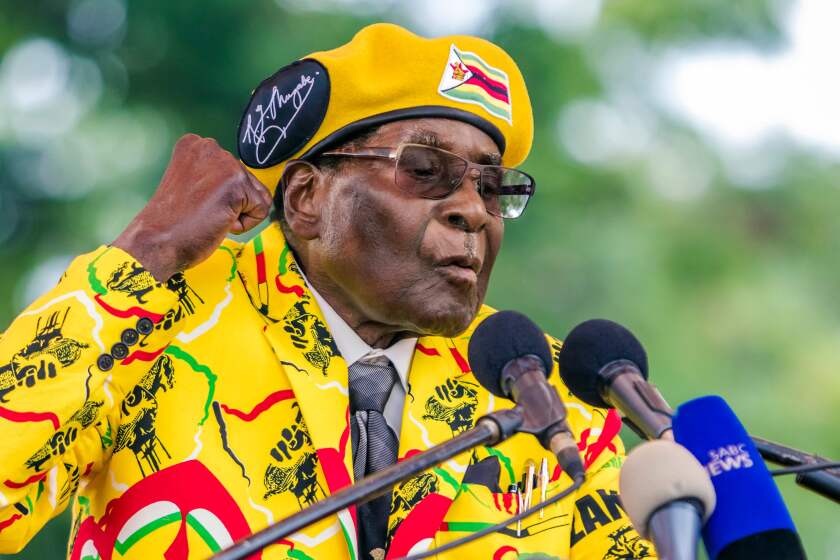
Zimbabwean President Robert Mugabe in 2017.

Emmerson Mnangagwa, who stepped in as Zimbabwe’s president after Mugabe was forced from office in November 2017, hailed his longtime colleague and ally as “an icon of liberation, a pan-Africanist who dedicated his life to the emancipation and empowerment of his people.”

That sentiment was echoed by other African leaders. South Africa’s President Cyril Ramaphosa called Mugabe an “outstanding” and “gallant” leader in the African independence movement who came to South Africa’s aid during its own freedom struggle. Kenyan President Uhuru Kenyatta praised Mugabe for being “a man of courage who was never afraid to fight for what he believed in even when it was not popular.”

But many Zimbabweans expressed a deep sense of conflict over his passing, recognizing his contribution to ending white rule but unwilling to gloss over the devastating and lasting impact that his decades in power had on millions of people.

Though it has been two years since Mugabe left office, unemployment remains rampant and millions have been forced to find work overseas. Those who have stayed face unreliable public services and regular shortages of basics such as fuel and food.

On Friday, many pointed out on social media that as his health declined, Mugabe had sought medical treatment in the well-appointed hospitals of Singapore, where he died, an indictment of the broken health system he left behind in his homeland.

The political culture that he cultivated will be difficult to dislodge, critics argued.

David Coltart, a member of Zimbabwe’s opposition alliance, acknowledged there were positive impacts of Mugabe’s presidency, such as the country’s enduring education system.

But, he wrote on Twitter, “the negative aspects of his legacy — violence, disrespect for the rule of law, corruption and abuse of power — live on in the new regime which overthrew him.”

Nelson Chamisa, the leader of the Movement for Democratic Change who challenged Mnangagwa in the 2018 polls, extended his condolences to Mugabe’s family but also said on social media that his party “and the Zimbabwean people had great political differences with the late former President during his tenure in office, and disagreed for decades.”

“It is reality that the death of Mugabe brings mixed feelings to different sections of the Zimbabwe community, the nation, and the world as a whole,” said Bongani Mazwi Mkwananzi, a representative of the Zimbabwe Community South Africa, where more than a million Zimbabweans live. “Some will celebrate his death, and some will mourn.”

Mahr is a special correspondent.

Posted in Blog | Leave a comment

A history of abductions, assassinations

The Standard

1st September 2019

October 15, 1975: Edson Sithole and his secretary Miriam Mhlanga were grabbed by unknown assailants, bundled into a car and were never seen again. A few weeks earlier, Sithole had fallen out with other nationalists leading to a split of the UANC and the reshuffling in the ranks of both Zapu and Zanu — seven months after the assassination in Lusaka — of Herbert
Chitepo. Although still officially missing 44 years later, an empty grave bears his name at national Heroes Acre.

1989: Captain Edwin Nleya disappeared in suspicious circumstances from an Infantry Battalion in Hwange. His body was found on a hillside in Hwange two months later. Nleya had threatened to expose senior army officers who were involved in poaching and smuggling ivory outside the country.

May 1990: Rashiwe Guzha, a secretary in the Central Intelligence Organisation (CIO), disappeared. At the time of her disappearance, Guzha had just broken off an affair with the then CIO deputy director Edson Shirihuru. Although an inquiry was set up by government, the results were never made public. Because her remains were never found, many believe she was killed and her body might have been dissolved in acid.

Early 90s: Marceline Dzumbira worked for the Reserve Bank of Zimbabwe and disappeared shortly after she had allegedly kidnapped her husband’s alleged mistress. She has not been found.

June 19 2000: Patrick Nabanyama, who was a polling agent for David Coltart in the violent June 2000 parliamentary election, disappeared after being abducted on June 19, 2000. A gang of up to 10 armed suspected Zanu PF activists, driving a white Mazda truck with no number plates, reportedly descended on Nabanyama’s house and abducted him. He was never seen again.
Bulawayo provincial magistrate Rose Dube officially declared Nabanyama dead on August 11, 2010.

November 5, 2001: Cain Nkala, a Bulawayo war veterans’ leader, was abducted from his home by 10 men armed with Kalashnikov assault rifles. He was taken away in a truck and later strangled to death. His body was found in a shallow grave near Solusi University on November 13. Nkala had been charged in connection with the abduction and “disappearance” on June 19, 2000 of Nabanyama, the election agent for MDC MP David Coltart. Nkala was alleged by several witnesses to be one of the war veterans who beat Nabanyama at his home in Nketa, bundled him into a car and took him to their offices. Nabanyama was never seen alive again.

May 13, 2008: Tonderai Ndira was a prominent activist and member of the MDC who was arrested on 35 occasions, and was reportedly described by his followers as “Zimbabwe’s Steve Biko”. He was abducted from his home by 10 armed men in the morning of May 13, 2008, in the context of campaigning between the two rounds of the 2008 presidential elections. His body was found later in the month. Reports said he had been shot in the heart, had multiple stab wounds, his eyes were gouged, his tongue was cut out and his neck, skull, jaw and knuckles were broken.

July 17, 2008: Abigail Chiroto was kidnapped by armed men who then petrol-bombed the house she shared with her husband, Emmanuel Chiroto, the then recently elected Harare deputy mayor under the MDC. Her blindfolded body was discovered close to the couple’s house the next day.

December 3 2008: Jestina Mukoko, human rights activist, director of the Zimbabwe Peace Project and former ZBC newsreader, was abducted during the night from her home by suspected state agents for allegedly being involved in plans for anti-government demonstrations on December 3, 2008. After three weeks, Mukoko appeared at a police station being charged with recruiting persons to participate in alleged militia training in Botswana. In March 2009, she was released on bail. On September 21, 2009, the Supreme Court ordered a permanent stay of criminal proceedings against Mukoko.

February 8, 2012: Paul Chizuze, a prominent human rights activist, vanished under unclear circumstances. He was last seen around 8pm on that day when he left his home. His whereabouts remain a mystery. It is feared that he was abducted and murdered by political rivals.

March 9, 2015: Freelance journalist and pro-democracy activist Itai Dzamara (35) was taken by five unknown assailants from a barbershop in Glen View, while he was getting a haircut. Four years later, he is still missing.

August 21, 2019: Samantha Kureya (Gonyeti) was abducted in the dead of the night from her house by people who identified themselves as police. She was bundled into an Isuzu truck, which drove to an unknown place where she was beaten up, forced to roll in sewage and to drink it as punishment for “mocking the government”.

Posted in Blog | Leave a comment

Chief Ndiweni’s bail application hits brick wall

Bulawayo 24 News

By Mandla Ndlovu

27th August 2019

The application by jailed Nhlambabaloyi Chief Felix Nhlanhlayamangwe Ndiweni to get his bail pending appeal granted on Tuesday was frustrated by the State prosecutor who asked for time to respond to Chief Ndiweni’s bail application.

Reports from High court say the prosecutor said the Magistrate has still not supplied reasons for sentencing. The presiding Judge Mabhikwa said the state should avail its response to the bail application and heads of arguments by 4.30pm today.

The case for bail hearing will be heard in court tomorrow (Wednesday) at 10AM.

Last week we reported that a member of the dreaded Central Intelligence Organisation told this publication that the full judgement by the magistrate was a sensitive one and an instruction was issued that it must not be provided to the lawyers and the public but be kept under lock and key.

Commenting on the latest developments MDC Treasurer General David Coltart said, “It is appalling that the State isn’t ready to argue the matter resulting in Chief Ndiweni having to spend another night in detention in the disgusting conditions prevailing at Khami Prison.

“I question how often the Minister of Justice, Judges, Magistrates and State Prosecutors visit and inspect conditions in police cells and prisons. The flippant way in which negligence, or worse, malice, is allowed to deny citizen’s fundamental rights to liberty is shocking.”
Ndiweni is being represented by Professor Welshman Ncube and Dumisani Dube of Mathonsi law chambers.

Legal gurus like Josphat Tshuma and David Coltart attended the event.

Posted in Blog | Leave a comment